

Starting a boutique business means building a small, curated shop around one clear shopper, then stocking what that shopper buys. ZenBusiness, a business formation company, estimated in July 2026 that women’s clothing boutiques average $150,000 to $500,000 in annual revenue.
I’m Michal Sieroslawski, and I help boutiques show up in Google and AI search. ChatGPT and Google’s AI Overviews now suggest boutiques by name, and that list matters.
The order below settles the cheap decisions first. Concept and pricing shape the budget, and the budget shapes the lease and the first wholesale order. Opening a boutique business follows the eleven steps below.
- Define Your Boutique Concept
- Write a Boutique Business Plan
- Price Your Merchandise
- Fund the Opening Inventory
- Register the Boutique and Its Tax Accounts
- Choose a Storefront or Online Base
- Source Wholesale Stock
- Set Up Sales and Inventory Systems
- Market the Boutique Opening
- Hire Help and Grow Repeat Sales
- Show Up When Shoppers Ask Google AI Mode
1. Define Your Boutique Concept
A boutique concept means the specific style, shopper and price range the shop commits to. A sharp concept makes buying, branding and marketing far easier than a general clothing store.
Most boutiques pick one lane. Women’s fashion, menswear, children’s wear, plus-size clothing and vintage each attract a different buyer. A single lane also keeps the racks looking like one collection.
Price tier is part of the concept too. Budget shops sell trend pieces fast at low prices, while premium shops sell fewer, pricier pieces. Mid-range suits most new shops. The tier must match what the target shopper can pay.
The target shopper needs a written profile. Age, income, favourite styles and shopping habits all go on one page. That profile later decides every wholesale order and every social post.
A concept is complete when it fits one sentence: style, shopper, price tier and one clear difference. That difference can be a size range, a local-designer focus or a styling service. A shop that cannot finish the sentence needs more work.
Competitor visits reveal the gaps. Local shops and online boutiques show which styles and price points are already covered. A missing size range or an absent style is often the opening a new shop needs.
Testing comes before commitment. A weekend pop-up, a trunk show or a short customer survey shows whether the target shopper responds. Free advice from a local small business advisor can also challenge the idea.
Some founders choose a franchise instead of an independent shop. Apricot Lane Boutique is a fashion boutique franchise that sells branded apparel and accessories. It grew from a family-owned gift shop in California. Independent owners keep full control of buying and branding.
2. Write a Boutique Business Plan
A boutique business plan sets the concept, numbers and daily operations down in one document. Lenders read it, and the owner uses it to test whether the idea pays.
Sections of a boutique business plan:
| Section | What it covers |
|---|---|
| Executive summary | Concept and mission in brief |
| Market analysis | Target shopper, competitors, unique angle |
| Product selection | Clothing and accessory categories |
| Marketing strategy | How the shop attracts and keeps customers |
| Operational plan | Staffing, inventory and daily routines |
| Financial projections | Revenue and expense estimates |
Self-funded owners can start with a lean plan. That shorter version keeps the founder on track without a long formal document. A lean plan converts into a full plan when a bank or investor asks for one.
The plan also names the risks. Slow-selling stock, a weak location and seasonal dips are the usual ones. Each risk gets a backup, such as a markdown schedule or a smaller first order.
The sales forecast is the plan’s most important assumption. Projected monthly sales decide how much inventory the boutique buys before opening. An optimistic forecast leaves the shop overstocked and short of cash.
3. Price Your Merchandise
Merchandise pricing determines whether each sale covers its wholesale cost, rent and staff time. A boutique resells goods, so the markup on every item carries the whole business.
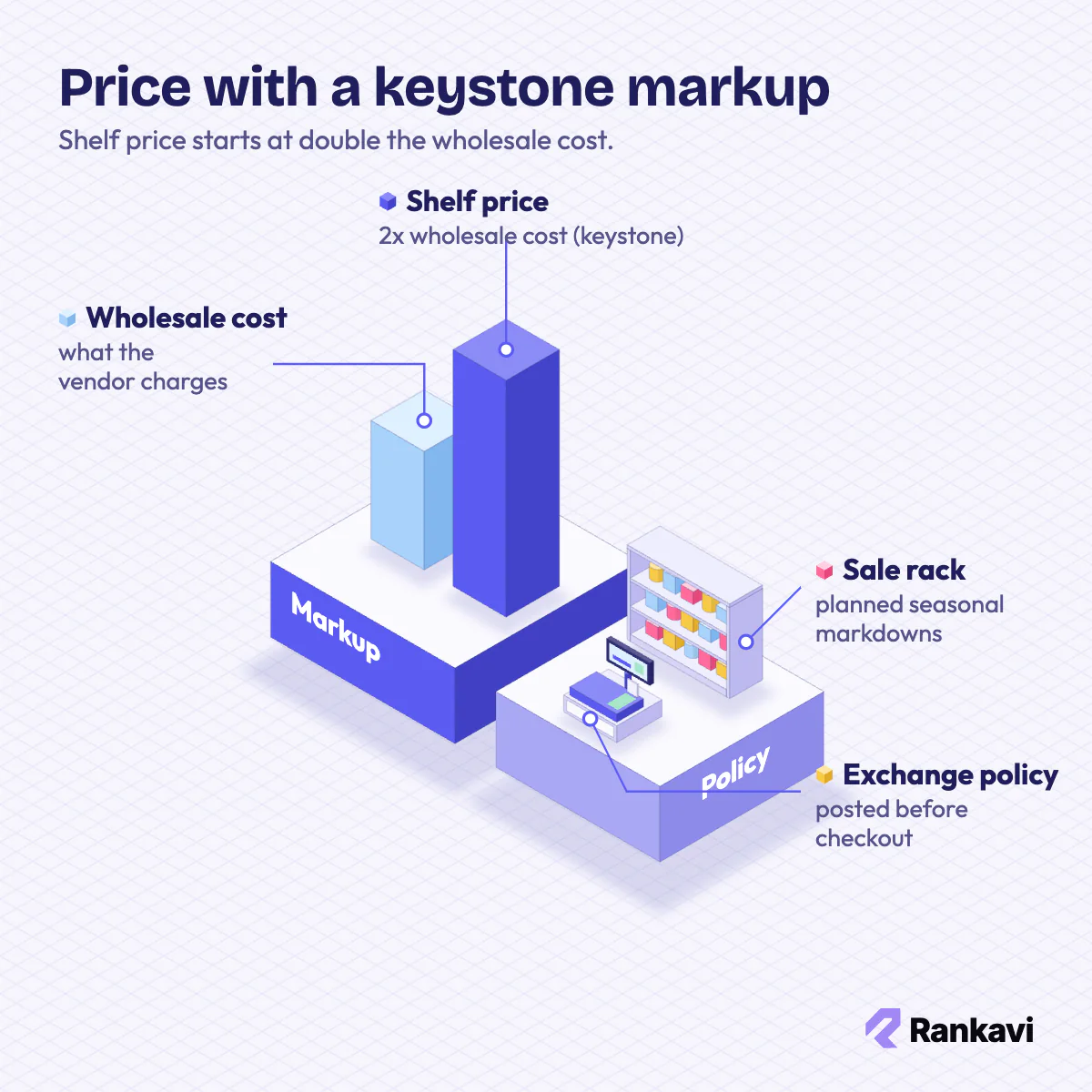
Keystone pricing is the common starting point in apparel retail. The retailer doubles the wholesale cost to set the shelf price. Many owners treat keystone as a floor, not a ceiling.
Keystone is a starting point, not a rule. Fast trend pieces may sell below it, and exclusive or hard-to-find items may sell above it. Each price still has to cover rent and staff time.
The price band follows the concept. Affordable trend pieces sell in volume, while premium labels sell fewer units at higher prices. Mixing both on one rack confuses shoppers.
Markdowns belong in the pricing plan from day one. Seasonal leftovers go on sale so cash returns for new stock. Planned sales protect margin better than panic discounts.
A clear exchange policy supports the price. Shoppers buy more confidently when returns and exchanges are posted before checkout. Many boutiques offer store credit instead of refunds.
Pricing also affects how the shop looks. Prices set too low can signal poor quality. Prices set too high can keep out the target shopper. Checking nearby competitors shows where the concept fits.
4. Fund the Opening Inventory
Boutique funding covers the opening stock, the shop fit-out and the months before sales catch up. Inventory and build-out usually take the largest shares of the first budget.
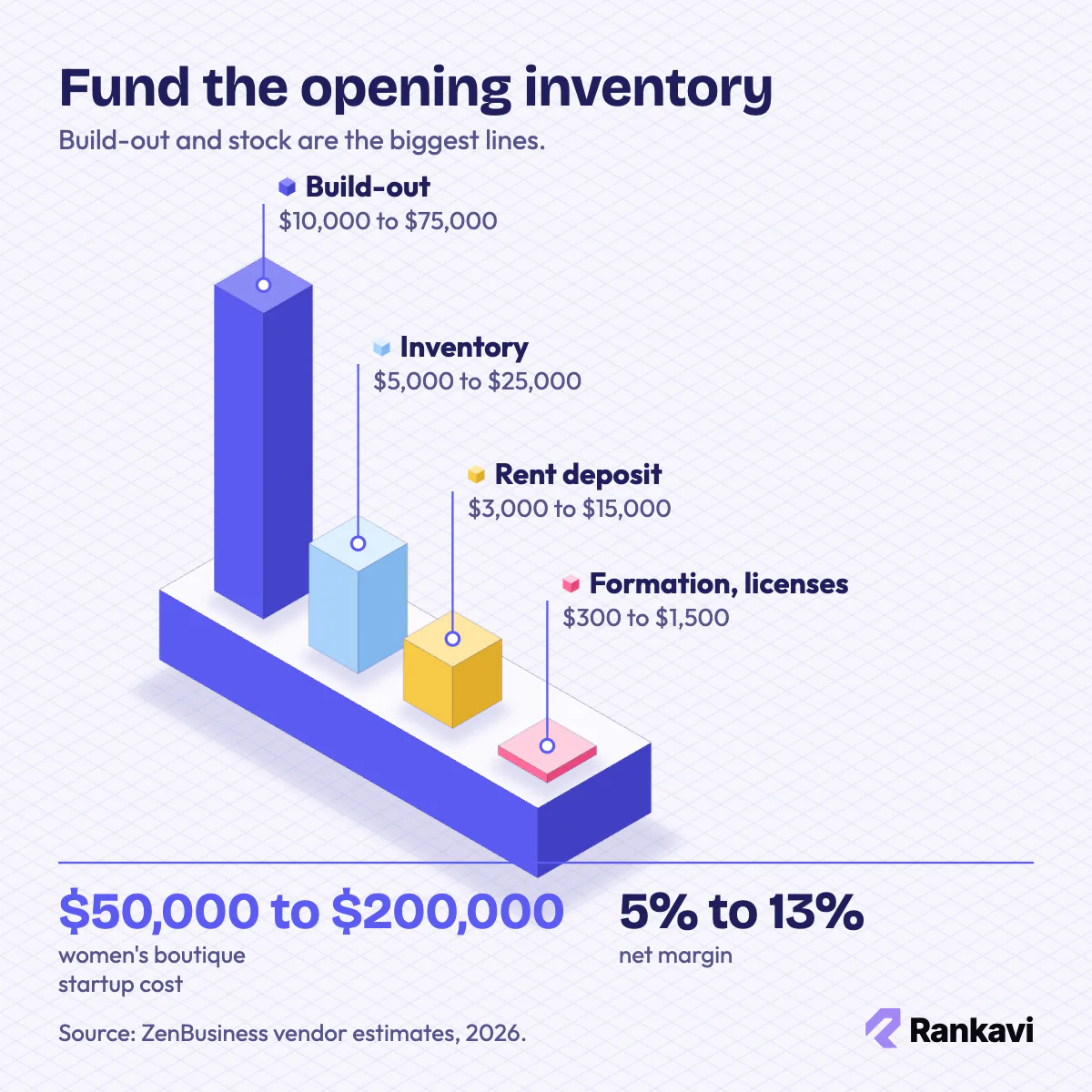
Startup money at a glance:
| Item | Typical figure |
|---|---|
| Startup cost | $50,000 to $200,000 for a women’s clothing boutique storefront; from about $5,000 for a small kiosk |
| Main costs | Store build-out $10,000 to $75,000; initial inventory $5,000 to $25,000; rent deposit $3,000 to $15,000; formation and licenses $300 to $1,500 |
| Typical margin | 5% to 13% net margin |
| Time to open | Varies with lease negotiation, build-out and vendor lead times; no independent figure found |
Sources: ZenBusiness, a business formation company, vendor estimates from its July 2026 boutique profile and September 2026 boutique guide.
The Boutique Hub is a community that offers training to boutique owners. As of 2026, its guide advises opening stock worth 2.5 to 3 times projected monthly sales. That ratio links the sales forecast directly to the inventory budget. Its guide counts the stock at retail price, not wholesale cost.
Worked example: An illustrative boutique forecasts $20,000 monthly sales and opens with 2.5 times that, $50,000 at retail. At keystone, that stock costs $25,000. Build-out ($20,000), deposit ($5,000), setup ($2,000) and marketing ($3,000) bring launch to $55,000. Selling everything at full price earns a $25,000 gross margin, under half the budget, so break-even needs several stock turns.
Personal savings fund many first boutiques, while banks, online lenders and crowdfunding fill the gap. The U.S. Small Business Administration (SBA) offers microloans and guarantees 7(a) bank loans for small retailers.
Break-even takes patience in clothing retail. ZenBusiness estimated in July 2026 that a women’s boutique needs 2-3 years to break even. Rent, payroll and restocking all compete for the same early sales.
Funding choices carry trade-offs. Savings cost no interest but put personal money at risk. Loans spread the cost but add monthly payments before sales are steady. Crowdfunding tests demand but needs a strong story and an audience.
5. Register the Boutique and Its Tax Accounts
Registering a boutique creates the legal business that buys wholesale, collects sales tax and signs the lease. Clothing retailers handle this step once funding is lined up.
Most boutique owners choose a limited liability company (LLC) or a sole proprietorship. Under a sole proprietorship, unpaid supplier invoices can reach the owner’s personal savings. An LLC shields personal assets if a customer or landlord sues.
The Internal Revenue Service (IRS) is the federal tax agency that issues an employer identification number (EIN) at no charge. Banks and payroll tools ask for it. A boutique trading under a brand name that differs from the owner’s legal name registers a doing business as (DBA) name.
A state sales tax permit lets the shop collect tax on clothing sales. That permit also supports a resale certificate. Wholesale vendors often ask for one before they open an account.
A separate business bank account keeps shop money apart from personal spending. A city or county business license completes the paperwork in most areas.
Some areas also require a certificate of occupancy for the space or a sign permit for the storefront. The city or county clerk confirms which local permits apply to the exact address.
6. Choose a Storefront or Online Base
The site decision decides how shoppers find the boutique and how much it pays every month. Storefronts need foot traffic, while online boutiques need a strong website.
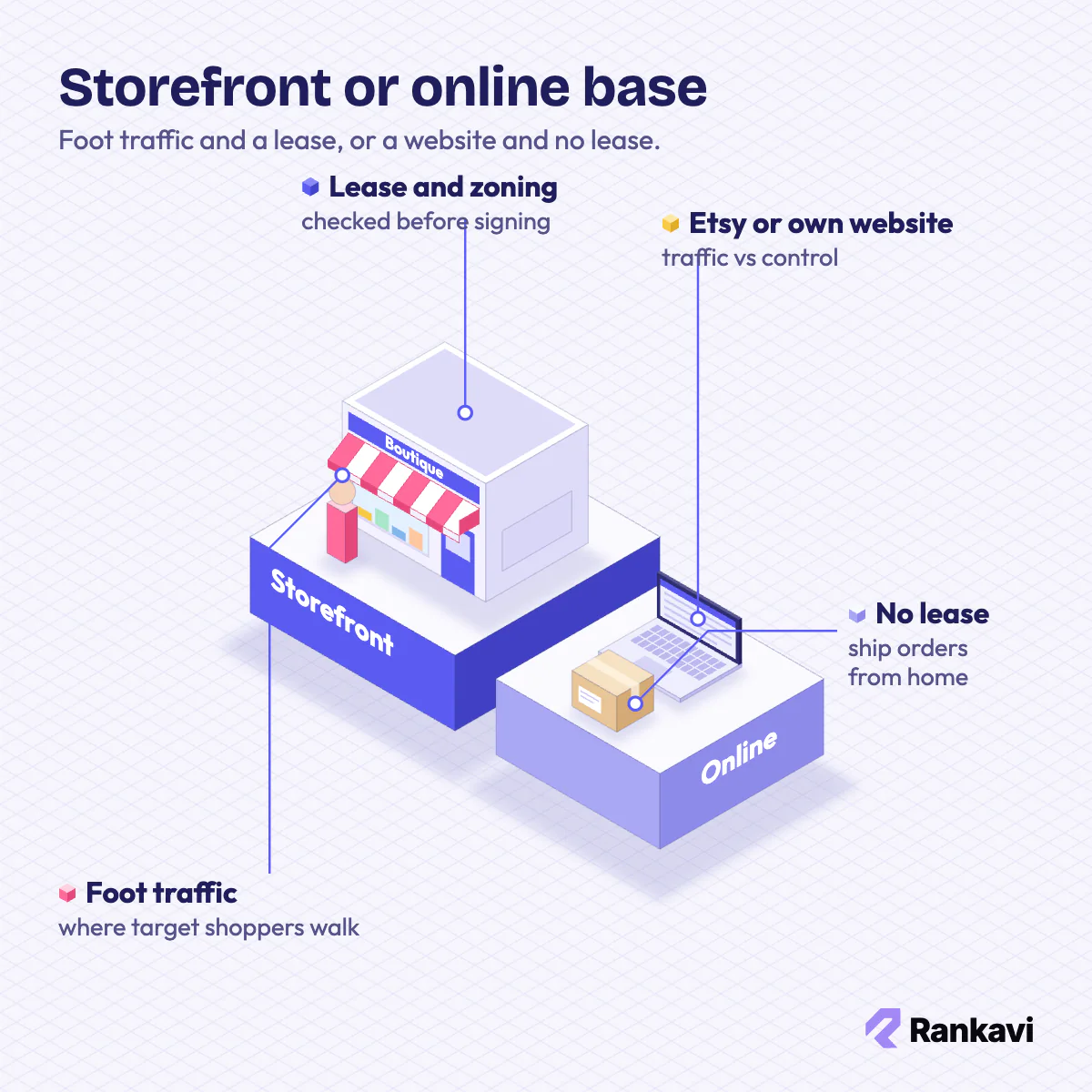
A good storefront sits where the target shopper already walks. Downtown shopping streets, lifestyle centres and busy neighbourhood strips all suit boutiques. A hidden unit forces the shop to spend more on marketing.
The lease deserves careful reading. Size, rent, renovation needs and lease length all affect the budget. Owners confirm local zoning before signing, because zoning and building permits depend on the exact address.
The interior sells the concept. Fixtures, lighting, fitting rooms and decor should match the shop’s style. A pleasant fitting room often decides whether a shopper buys.
Online boutiques skip the lease. Etsy is an online marketplace for handmade, vintage and craft goods with built-in shopper traffic. An own website offers more control over layout and branding. Many owners start online and open a store later.
Each base has a trade-off. A storefront builds trust and walk-in traffic but adds rent and fixed hours. An online shop costs less to open but depends on photos, shipping and paid reach. Some owners start with pop-ups to test a location first.
7. Source Wholesale Stock
Sourcing stock involves finding vendors whose quality, style and prices fit the concept. The opening order fills the racks and sets the shop’s first impression.
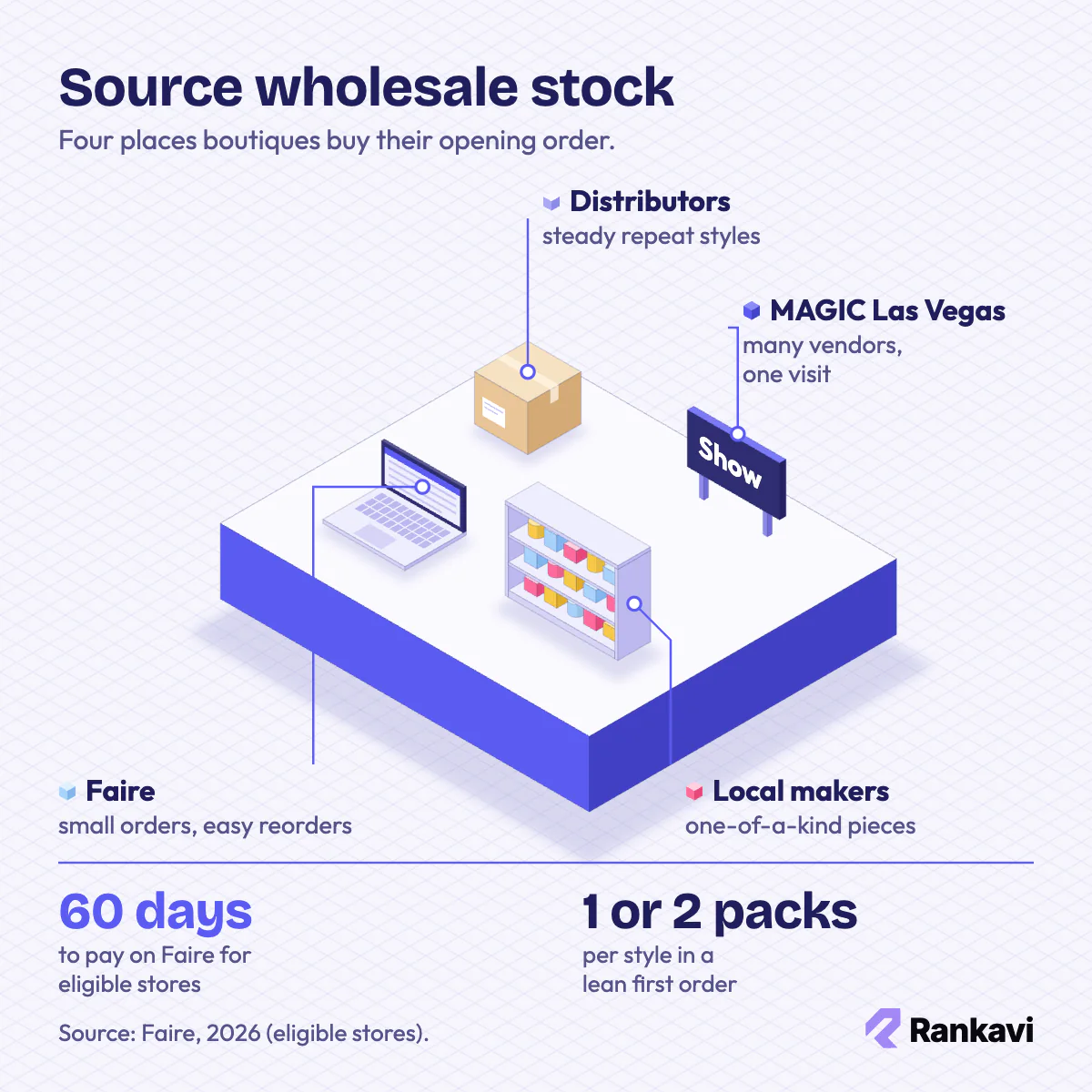
Wholesale distributors supply most boutiques. Fabric quality and consistent sizing matter as much as price. Owners order samples before committing to a large order.
Trade shows put many vendors in one room. MAGIC Las Vegas is a twice-yearly fashion trade show run by Informa Markets. It gathers apparel brands with retail buyers from big-box chains to small boutiques. Buyers see the fabrics in person and write orders on the spot.
Online wholesale marketplaces suit small first orders. Faire is a wholesale marketplace where independent stores buy from brands with low or no minimums. As of 2026, Faire gives eligible stores 60 days to pay and free returns on a first order with each brand. Local makers, Etsy sellers and vintage dealers add pieces no rival carries.
Main wholesale sources for a boutique:
| Source | Main advantage |
|---|---|
| Wholesale distributors | Steady supply and repeat styles |
| Trade shows | Many vendors and fabrics in one visit |
| Online marketplaces | Small orders and easy reorders |
| Local makers and vintage dealers | One-of-a-kind pieces |
The first order should stay lean.
New shops should check each vendor’s minimum order, delivery time and return terms before ordering. Late deliveries miss the season, and strict minimums can force a bigger bet than the budget allows. Buying one or two packs per style tests demand before deeper commitments. Owners reorder winners and drop the slow styles.
8. Set Up Sales and Inventory Systems
A point of sale (POS) system connects every sale to the stock count, the books and the online store. Boutiques need one system for both the counter and the website.
Inventory tracking prevents two costly mistakes. Stockouts lose sales, while overstock ties up cash in slow styles. Tracking by style, size and colour shows exactly what sells.
The online store and the shop should share one stock list. Shopify is a Canadian commerce platform that runs online stores and in-person checkout from the same inventory. Shared stock stops the shop from selling the same dress twice.
Shoppers expect several ways to pay. Cards, contactless payments and mobile wallets all belong at the counter.
The POS should also handle returns, exchanges and gift cards. Receipts that show the style, size and price make exchanges quicker. Reports from the system show the best sellers by week. Fewer payment options mean more abandoned purchases.
Bookkeeping starts on day one. Accounting software records every sale and expense, including inventory purchases. Clean books make sales tax filings and income tax returns far simpler.
9. Market the Boutique Opening
Opening marketing turns local curiosity into the first paying customers. Boutiques sell an experience, so the launch should show the shop’s style clearly.
Four channels drive most boutique openings:
- Grand opening event: giveaways, discounts and special guests on the first day
- Instagram and TikTok: outfit videos, new arrivals and behind-the-scenes clips
- Email list: early-access sign-ups collected before the doors open
- Local collaborations: joint events with salons, cafes and nearby shops
Product photos carry the online sale. Clean backgrounds, good lighting and real models help shoppers judge fit. A phone and a simple backdrop work at first.
Brand ambassadors spread the word cheaply. Local influencers and loyal customers who share outfits reach shoppers ads miss. Encouraging customers to post their purchases adds free reach.
A Google Business Profile helps local shoppers find the shop on maps and in search. Accurate hours, photos and reviews build trust before anyone visits. Replying to reviews shows that the owner pays attention.
10. Hire Help and Grow Repeat Sales
Growth keeps first-time shoppers returning while the owner hands off routine work. Repeat customers carry most small boutiques through slow months.
The first hire usually covers the sales floor. The U.S. Bureau of Labor Statistics (BLS), which publishes federal wage data, reported median pay of $17.03 an hour for retail salespersons in May 2025. Owners look for people who love fashion and enjoy helping shoppers. Training covers products, styling tips and how to greet customers.
Seasonal help can cover holidays without a permanent hire. Owners check whether a worker is an employee or an independent contractor, because tax and payroll rules differ.
Customer feedback guides the next buy. Comments, reviews and questions at the counter show which styles and sizes shoppers want. Owners act on that feedback in the following season.
Sales data shows where to grow.
A loyalty program or an email list brings regulars back between seasons. Personal notes, early access to new arrivals and styling appointments give shoppers a reason to return. Best sellers get deeper reorders, and slow categories shrink. Holiday events, trunk shows and an online store add new sales once the basics run smoothly.
11. Show Up When Shoppers Ask Google AI Mode
AI visibility means a boutique appears by name when shoppers ask an AI assistant where to buy. Questions like “cute boutiques near me” or “best boutique for linen dresses” now go to Google AI Mode.
Those assistants lean on what independent sites already say. Local guides, gift roundups, fashion blogs and review pages supply the names an answer repeats. A new boutique that earns those write-ups early is easier for an assistant to mention.
Rankavi is a software as a service (SaaS) platform that publishes brand mentions in articles on indexed third-party websites. Boutique owners who want those write-ups can start with third-party mentions for Google AI Mode.