

Starting a credit repair business means helping consumers dispute inaccurate credit report items under strict federal and state rules. The U.S. Bureau of Labor Statistics (BLS) projects 3% job growth for credit counselors from 2025 to 2035.
My name is Michal Sieroslawski. I help credit repair businesses appear when clients search online. ChatGPT and Google’s AI Overviews now suggest credit repair businesses by name, and that list matters.
The order settles the services and fee rules before money is spent. Registration, bonding and software then match the plan. Opening a credit repair business follows the twelve steps below.
- Choose Your Credit Repair Services
- Research Client Demand and Competitors
- Write a Compliance-First Business Plan
- Price Within the Advance Fee Rules
- Fund the Startup Budget
- Register the Company and Open Accounts
- Learn CROA and State Registration Rules
- Post the Surety Bond and Insure
- Build the Dispute Software Stack
- Market to Borrowers and Referral Partners
- Scale With Staff and New States
- Surface When Borrowers Ask AI
1. Choose Your Credit Repair Services
A credit repair service menu defines which credit problems the company fixes and which clients it serves first. Clear scope also keeps every promise inside what the law allows.
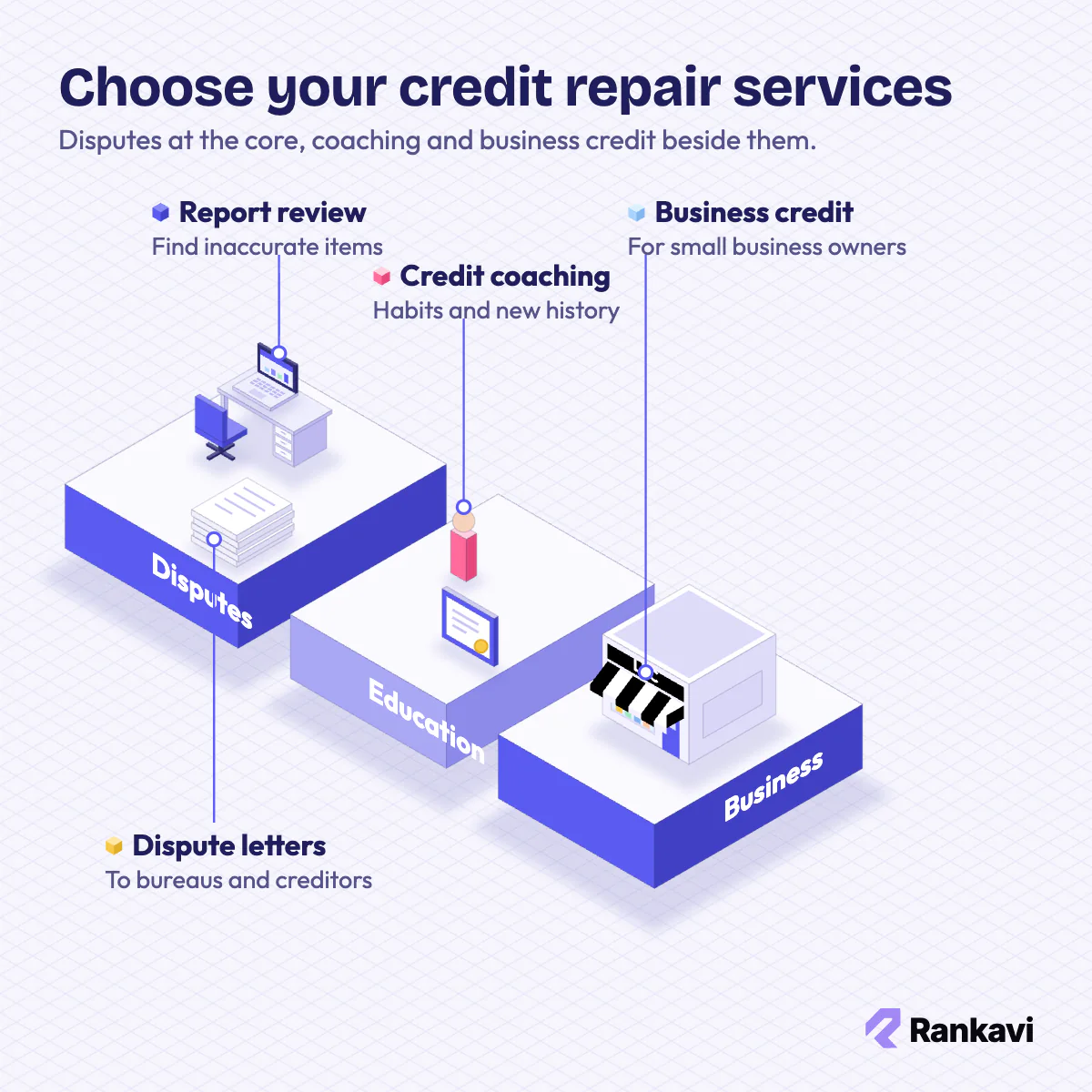
Dispute work is the core service. The company reviews a client’s credit reports and finds inaccurate or unverifiable items. Dispute letters then go to the credit bureaus and creditors. Each round of letters follows a written plan.
Disputes target errors, duplicate accounts, wrong balances and entries a creditor cannot verify. Accurate negative items stay on the report until they age off, so no service promises their removal.
Consumers can file disputes for free. A paid service sells report analysis, a dispute strategy and steady follow-through. Delivery varies: some firms send every letter, some coach clients who send their own, and some mix both.
Credit education sits next to disputes. Many clients need help with payment habits, card balances and building new positive history. Coaching keeps results from slipping after the disputes end.
Business credit is a separate niche. Some companies help small business owners build a business credit file alongside their personal scores. That offer suits founders who apply for equipment loans or supplier accounts.
The target client shapes the whole menu. First-time homebuyers, car buyers and people recovering from identity theft each need a different mix of disputes and coaching.
A narrow start works best. One core service, one supporting service and one client group keep the menu manageable. More services follow once demand is proven.
Some services fall outside credit repair. Debt settlement, bankruptcy preparation and legal advice are separate businesses with their own rules. Schemes such as new credit identities are illegal and stay off every menu.
2. Research Client Demand and Competitors
Demand research measures how many consumers struggle with credit reports and who already sells them help. The answer decides whether the company targets a city, a state or one client group.
The Consumer Financial Protection Bureau (CFPB) is the federal agency that takes consumer finance complaints. It received about 6.6 million complaints in 2025. Its 2025 Consumer Response Annual Report put credit or consumer reporting at 88% of them.
Competitor research comes next. New owners study national firms and local credit consultants, note their packages and read their reviews. Gaps in service, speed of communication or education point to a sharper position.
Free alternatives set the bar. AnnualCreditReport.com is the official site for free credit reports from the three nationwide bureaus. Equifax, Experian and TransUnion made its free weekly reports permanent in September 2023. Consumers can also dispute errors directly at no cost. A paid service must explain clearly what it adds, such as organized disputes, follow-up and coaching.
A value proposition then sums up the position in one sentence. It names the client group and the problem solved, and it never promises a score increase.
Demand is easiest to judge locally. Complaint patterns and search interest in credit repair terms show how many people need help. Complaints show pain, not willingness to pay, so conversations with likely clients add the missing evidence.
3. Write a Compliance-First Business Plan
A credit repair business plan lists the services, the target clients and the rules that shape every sale. Compliance belongs in the plan because it limits pricing and marketing.
Core plan sections:
| Section | What it covers for a credit repair company |
|---|---|
| Services | Disputes, credit education and any business credit offer |
| Target market | The client group and the states it lives in |
| Compliance | Federal law, state registration and contract rules |
| Marketing | Referral partners, website and educational content |
| Financial projections | Client count, monthly fees and cash flow timing |
The state footprint is the key assumption. Rules follow the state where each client lives, so serving several states multiplies registrations and bonds. Most new owners plan for their home state first.
Client capacity is the second assumption. One owner can only manage a limited caseload of disputes well. The plan names the client count that triggers the first hire.
Cash flow is the third assumption. The forecast shows the first months with little revenue because fees follow completed work. Registration and bond costs enter the budget as fixed items.
4. Price Within the Advance Fee Rules
Pricing a credit repair service sets how and when the company may charge, not just how much. Federal law bans collecting fees before the promised work is fully performed.
Credit repair companies use three main pricing models:
- Monthly billing: a fee after each month of completed dispute work.
- Pay per delete: a fee only when a disputed item leaves the report.
- Tiered packages: disputes, coaching and monitoring bundled at different levels.
Monthly billing is the most common model. The company charges after each month of completed dispute work, which keeps payments tied to services already delivered.
Pay per delete is the second model. The client pays only when a disputed item leaves the report. That structure ties each fee to a visible result.
Broadview Federal Credit Union, a credit union, listed typical setup fees of $15 to $200 and monthly fees of $50 to $150 in March 2026.
Tiered packages group disputes, coaching and monitoring at different levels. Some firms add a first work fee for the credit analysis. Any fee still has to follow the advance fee rules.
Each model carries a trade-off. Monthly billing gives steady income but needs clients who stay engaged. Pay per delete ties fees to results but makes income uneven. Tiered packages are easy to explain but never include a prepaid fee.
A free consultation opens most sales. The company reviews the reports, explains the realistic options and avoids any guarantee about scores.
Sales by phone face stricter rules. The federal telemarketing rule sits in the Code of Federal Regulations (CFR). As of 2026, 16 CFR 310.4 delays those fees until a later consumer report shows the results. Many owners plan cash flow around that delay.
5. Fund the Startup Budget
Funding a credit repair business covers a small setup budget and the slow months before monthly fees arrive. The advance fee ban means income lags behind the work.
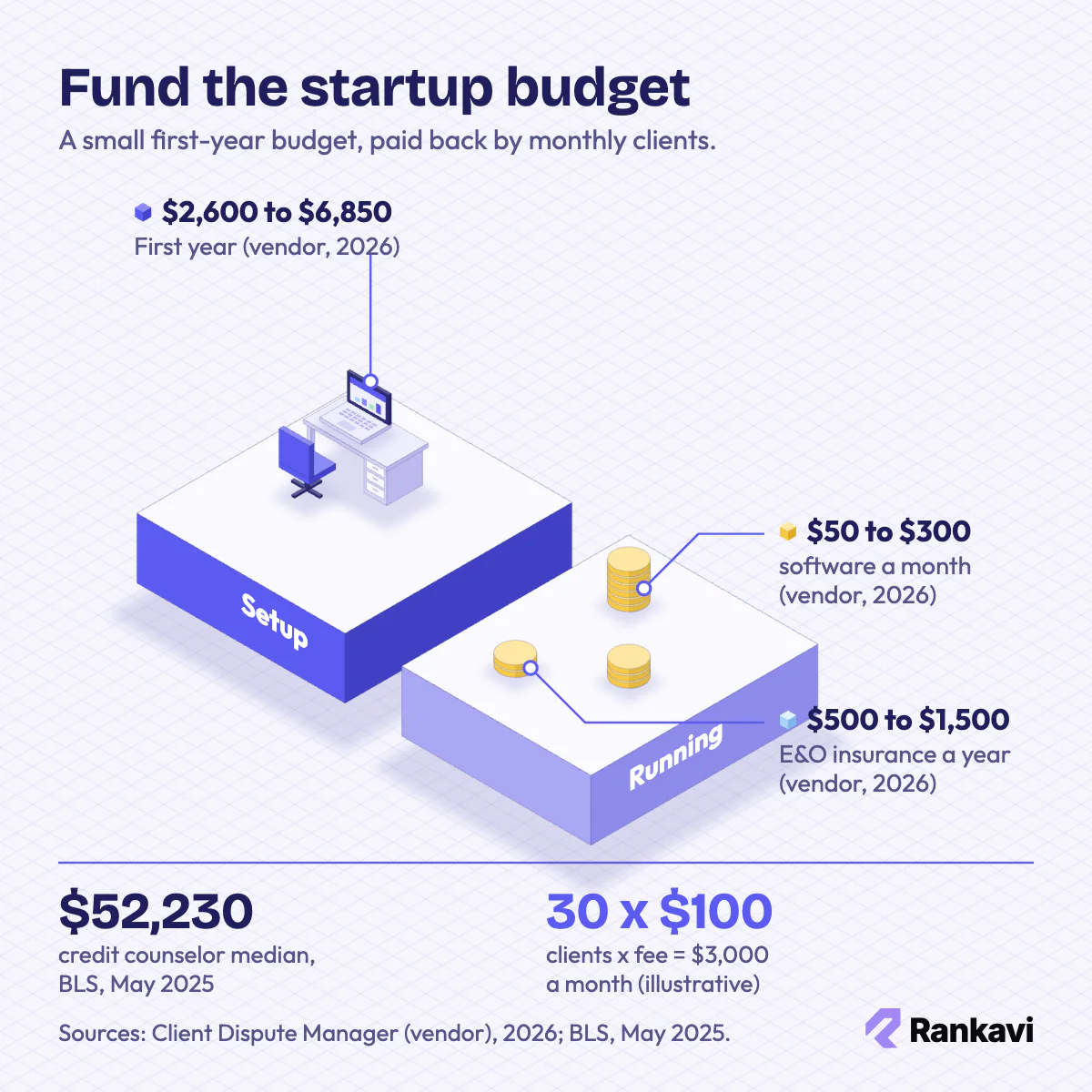
Client Dispute Manager is a credit repair software vendor. It estimated a first-year Texas budget of $2,600 to $6,850 in 2026. The same 2026 vendor estimate says most owners start for under $3,000.
Startup money at a glance:
| Item | Figure |
|---|---|
| Startup cost | $2,600 to $6,850 in the first year, most under $3,000 |
| Main costs | Entity filing, state registration and bond, dispute software at $50 to $300 a month, website at $500 to $2,000, errors and omissions insurance at $500 to $1,500 a year |
| Typical margin | No published figure for small credit repair firms; software and marketing are the main running costs |
| Time to open | About 2 to 4 weeks for the legal setup |
Sources: Client Dispute Manager (credit repair software vendor), 2026 vendor estimate for Texas; Serif.ai (business plan software vendor), 2025 vendor estimate for setup time.
The BLS reported a median annual wage of $52,230 for credit counselors in May 2025. That employee benchmark is the income a solo owner needs to beat.
Worked example: an illustrative home-based company signs 30 clients at $100 a month. Monthly revenue reaches $3,000. Subtracting a $179 software plan leaves $2,821 a month before marketing, insurance and taxes. At that client count, a $3,000 setup budget comes back in a little over one month of revenue.
Working capital matters more than equipment. Fees arrive only after work is done, so the owner covers software and marketing for the first months from savings.
Each funding route has a trade-off. Self-funding keeps full control but ties up personal savings. A small business loan speeds up marketing but adds a fixed payment while income is uneven. A part-time job lowers risk but slows client growth.
Most owners fund the company themselves. Savings, a part-time job or a small business loan bridge the gap until recurring clients cover expenses.
6. Register the Company and Open Accounts
Registering a credit repair company gives it a legal entity that signs client contracts and files state registrations. Most owners form a limited liability company (LLC) for liability protection.
An LLC keeps pass-through taxation and separates personal assets from business claims. The owner files with the Secretary of State and checks that the business name is available.
Credit repair firms apply for an employer identification number (EIN) from the Internal Revenue Service (IRS) at no cost. State registration forms and banks both ask for that number.
A separate business bank account keeps client payments apart from personal money. Clean records also help when a state regulator or surety reviews the company.
The entity choice is a trade-off. A sole proprietorship is the simplest to start but leaves personal assets open to business claims. An LLC adds paperwork and a state fee, which is why most owners accept it.
Home-based owners also check local zoning and homeowner association rules before clients or mail reach the address.
7. Learn CROA and State Registration Rules
Credit repair compliance covers the federal law every company follows and the state rules where each client lives. No federal license exists, but federal rules apply from the first client.
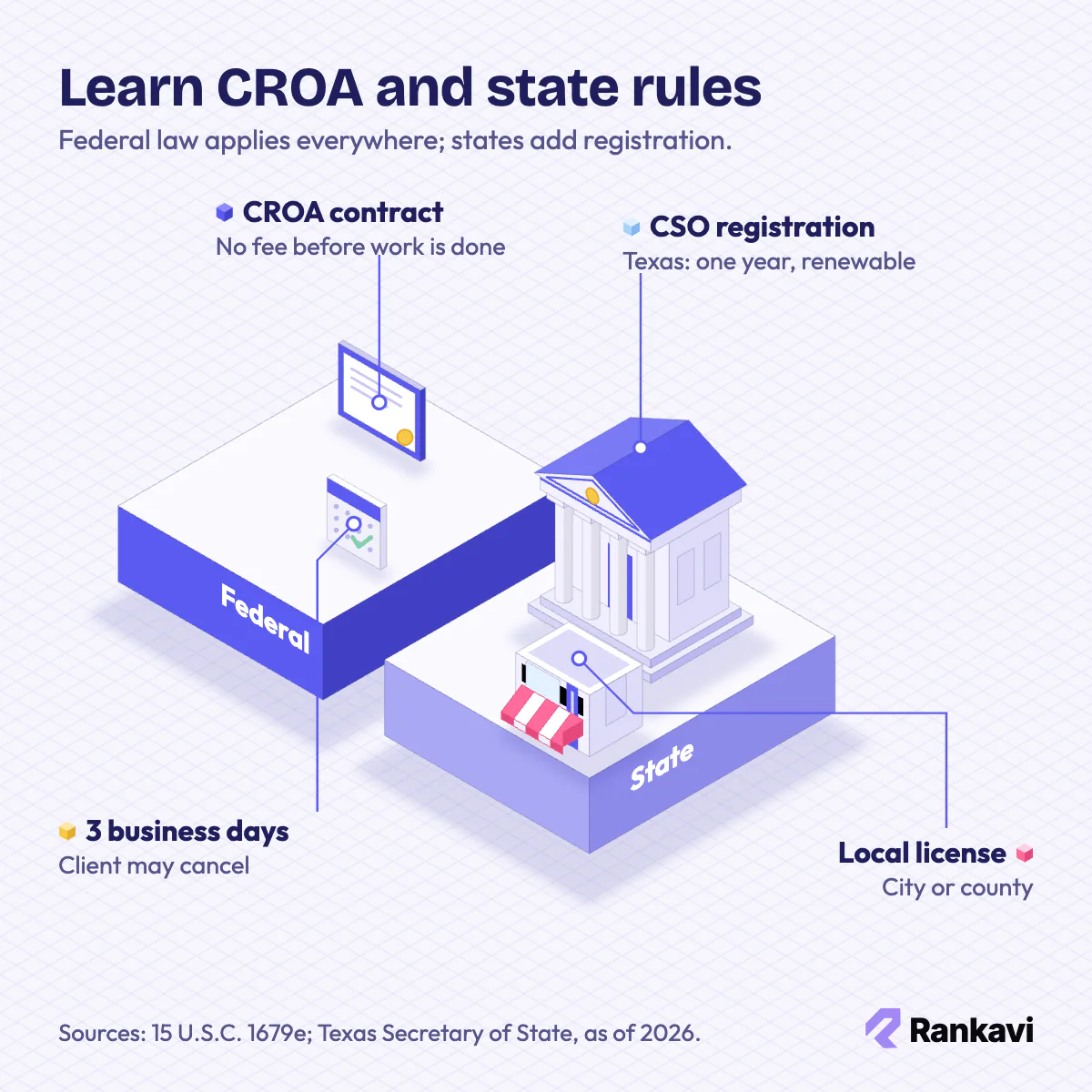
The Credit Repair Organizations Act (CROA) is the federal law for this business, enforced by the Federal Trade Commission (FTC). The FTC is the federal agency that enforces consumer protection law. CROA requires written contracts and a disclosure of consumer rights, and it bans untrue or misleading claims.
As of 2026, CROA (15 U.S.C. 1679e) lets a client cancel before midnight of the 3rd business day after signing. CROA also bans any fee before the service is fully performed.
The Telemarketing Sales Rule (TSR) is the FTC rule for phone sales. It delays fees for credit repair sold by telemarketing until the promised results are shown.
Many states require credit services organization (CSO) registration. Texas, for example, requires registration with the Texas Secretary of State before a company offers credit repair there. As of 2026, each Texas registration lasts one year and may be renewed.
Local rules come last. Many cities and counties require a general business license, even for one-person home offices.
State rules follow the client, not the office. A company based in one state that signs a client in another state follows the client’s state rules. The state registration agency lists the current requirements.
8. Post the Surety Bond and Insure
A surety bond protects clients if the company breaks state credit repair rules or fails to deliver services. Many states require one before registration is approved.
The bond is a three-party agreement between the company, the state and a surety company. The owner pays a yearly premium, not the full bond amount. Personal credit drives that premium.
Bryant Surety Bonds, a surety seller, listed the Texas bond at $10,000 per location as of 2026. In 2026, owners with a 700 or higher credit score may pay about 1%, or roughly $100.
Errors and omissions insurance covers claims of bad advice or mistakes in client files. It suits a business that handles disputes and financial guidance.
Cyber liability insurance covers data breaches. Credit repair files hold Social Security numbers and account details, so a breach is a serious risk.
A bond and insurance cover different risks. A bond pays clients when the company breaks the rules. Insurance pays for the company’s own legal costs and losses from mistakes or data breaches.
9. Build the Dispute Software Stack
Credit repair software keeps client files, dispute letters and bureau responses in one secure system. The software also runs the monthly billing.
A home-based credit repair company runs on four core tools:
- Credit repair software: Credit Repair Cloud is a dispute platform that generates letters and tracks rounds. Client Dispute Manager offers similar tools.
- Secure client portal: a place to upload reports, identity documents and signed forms.
- Payment processing: recurring billing that charges only after work is done.
- Credit monitoring: report access so the company sees changes from Equifax, Experian and TransUnion.
Credit Repair Cloud listed its Start plan at $179 a month for up to 300 active clients in October 2026. The plan includes a 30-day free trial.
Contracts come before any work. The written agreement lists services, the total cost, the time frame and the cancellation notice. An attorney review protects the company before the first client signs.
Onboarding follows a fixed order. The client signs the disclosure and contract, shares the reports and receives a dispute plan. Progress reports then follow each round. The FTC noted in April 2024 that a credit bureau has 30 days to investigate a dispute.
Software choice is a trade-off. All-in-one platforms save setup time but charge a monthly tier fee. Separate tools may cost less but take more work to connect. Either way, client files need limited access, since reports hold Social Security numbers.
10. Market to Borrowers and Referral Partners
Marketing a credit repair company turns trust into signed clients through referrals, education and visible reviews. Clients hand over sensitive data, so credibility comes first.
Referral partners bring the warmest leads. Mortgage loan officers, real estate agents and car dealers meet buyers who need better credit before approval.
Lenders and agents refer clients only to firms they trust, so timely updates on each referred client matter.
Educational content attracts people who are still learning. Blog posts, short videos and free webinars explain credit reports without promising results.
A clear website shows services, prices, the cancellation right and the company’s state registrations. Reviews on Google and the Better Business Bureau add proof.
Testimonials stay truthful and never imply that results are guaranteed.
Marketing claims stay inside the law. Credit repair ads may not promise to remove accurate negative items or guarantee a score.
11. Scale With Staff and New States
Scaling a credit repair business means adding staff, states and services once the owner’s caseload is full. Documented processes make that growth possible.
The first hire usually handles dispute processing or client communication. Written procedures keep quality steady when someone new touches client files.
Hiring carries trade-offs. Employees give direct control over client files but add payroll and training. Contractors add flexibility but handle sensitive data outside daily oversight. Either way, staff sign confidentiality agreements.
New states bring new clients and new paperwork. Each state may need its own registration and bond, so expansion follows a state by state checklist.
Industry membership adds credibility at this stage. The National Association of Credit Services Organizations is a nonprofit trade group of credit repair companies and their vendors. The National Association of Credit Services Organizations runs a Standards of Excellence seal for members.
Automation lifts capacity without new staff. Software that schedules letters, reminders and reports frees the owner for sales and partner meetings.
12. Surface When Borrowers Ask AI
People with damaged credit now ask ChatGPT, Gemini and Google AI Overviews which credit repair company to trust. Many of them search right before a mortgage or car loan.
Those AI tools repeat what trusted third-party sites say. Review sites, local directories and “best credit repair company” articles shape the names they suggest. A new company benefits from appearing on those pages early.
Consistent details help AI tools repeat a company correctly. The same business name, services and state registrations on the website, directories and review profiles avoid mixed signals.
Rankavi is a software as a service (SaaS) platform that publishes brand mentions in articles on indexed third-party websites. Owners who want citations in Google AI Overviews answers can start with accurate articles about their services.