

Starting a flood restoration business takes drying certifications, an insured company, commercial drying gear and steady referral partners.
My name is Michal Sieroslawski. I help water restoration companies show up in Google and AI search. AI chats are becoming how homeowners compare water restoration companies, so being included matters.
This order settles prices and cash before any license fee or bond is paid. Certification then comes before the gear it teaches crews to use. The path to a running flood restoration business runs through the ten steps below.
- Choose Water, Fire or Mold Restoration Work
- Price Jobs Around Insurance Estimates
- Fund the Gear and the Slow Insurance Payments
- Register and Insure the Restoration Company
- Earn IICRC Certifications and State Licenses
- Buy Drying Equipment and a Response Van
- Set Up Moisture Logs and Job Software
- Build Plumber and Agent Referral Networks
- Hire Technicians and Add Service Lines
- Enter Google AI Overviews for Water Damage Searches
1. Choose Water, Fire or Mold Restoration Work
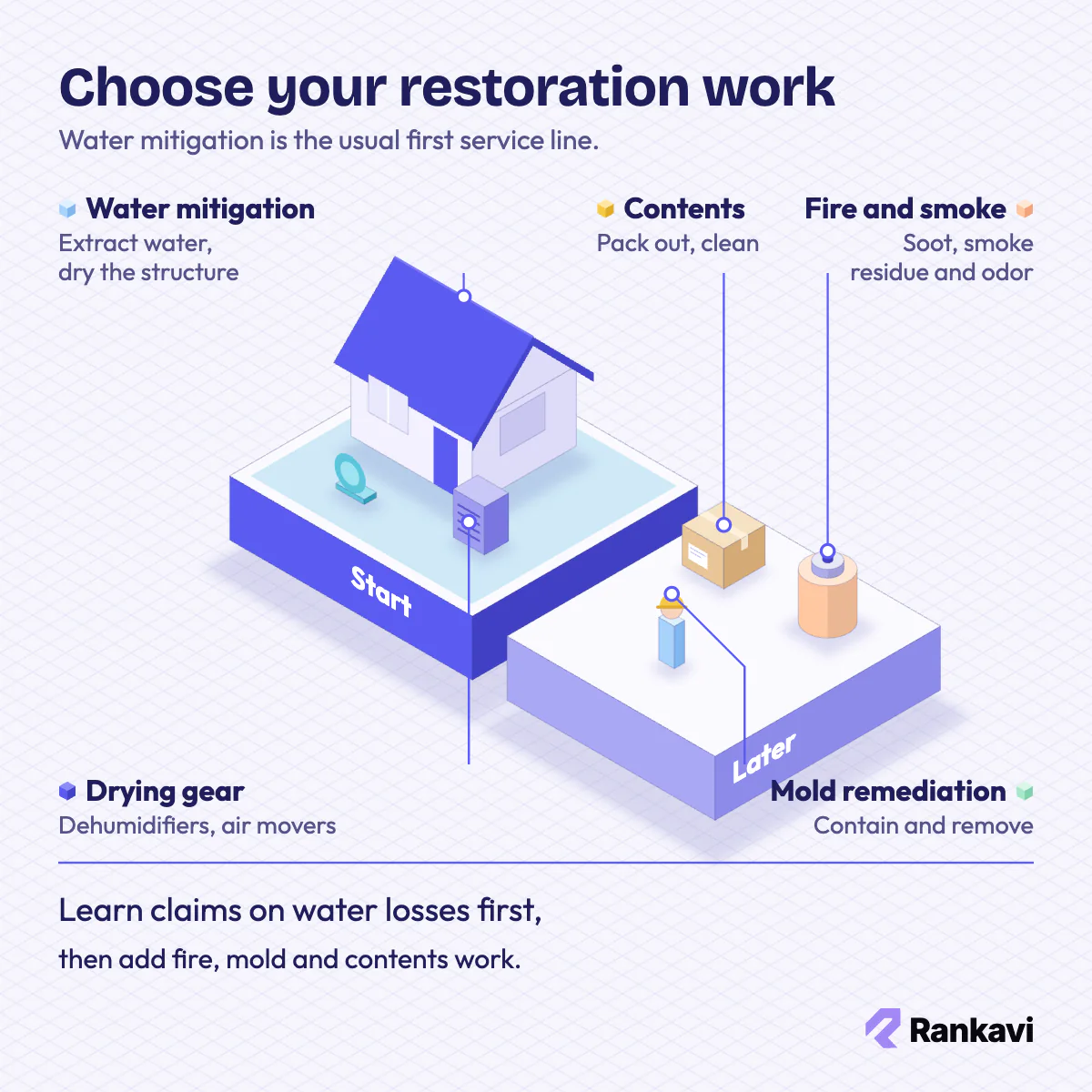
A new restoration company picks the kind of property damage it will answer first. Water mitigation, fire and smoke cleanup, mold remediation and contents cleaning each need their own training and gear.
| Service line | What the crew does |
|---|---|
| Water mitigation | Extracts standing water and dries the structure |
| Fire and smoke | Removes soot, smoke residue and odor |
| Mold remediation | Contains and removes mold growth |
| Contents cleaning | Packs out, cleans and stores belongings |
Water damage is the usual entry point. Most property claims start with a leak, a burst pipe or a flood, and adjusters handle these jobs daily. A new owner learns the claim process on simpler losses first.
Water type shapes the work. Standards sort water into three types: clean supply water, gray water from appliances and black water from sewage or floods. Flood jobs are often black water, so new crews usually start with cleaner losses.
Payment differs too. Standard homeowners policies usually exclude rising floodwater, so a flood job may be paid by a separate flood policy or by the owner. The standard policy usually covers burst-pipe losses.
Mold is a weak starting line. Some policies pay for mold only after a covered water loss, and some states license mold work separately. Fire and smoke work needs odor-control gear and a larger contents operation.
Mitigation-only companies dry the building and hand the rebuild to a general contractor. Full restoration firms also replace drywall, flooring and cabinets. That rebuild adds revenue but needs a contractor license and more staff.
Franchise brands such as PuroClean and DRYmedic sell training and a known name in exchange for fees. An independent company keeps full control of pricing and branding. Buying an existing firm brings ready insurer relationships.
Other franchise brands include ServiceMaster Restore, Paul Davis Restoration and Restoration 1. Each brand’s franchise disclosure document lists fees and territory terms. Franchises trade lower control for faster training and name recognition.
Local demand shapes the choice. Flood-prone areas lean toward water work, while dry regions see more fire and mold calls. Plumbers, insurance agents and property managers know which services are missing nearby.
Customer type matters as well. Homeowners call after hours and decide fast. Property managers and schools want quick response, full records and a vendor already on file.
2. Price Jobs Around Insurance Estimates
Restoration pricing sets each charge from the line-item estimates that insurance adjusters use to approve claims. Most flood jobs are paid by the homeowner’s insurer, not from the owner’s pocket.
Xactimate is Verisk’s claims estimating software, and it prices each task, such as extraction, air mover days and drywall removal. Adjusters compare the estimate with their own figures before they approve payment. Clean, complete estimates move faster through review.
Water damage is also sorted into four classes by how much of the structure is wet. Higher classes need more drying gear and more days, so the same floor area can cost more. Equipment is billed per unit per day, so a long dry-out raises the invoice.
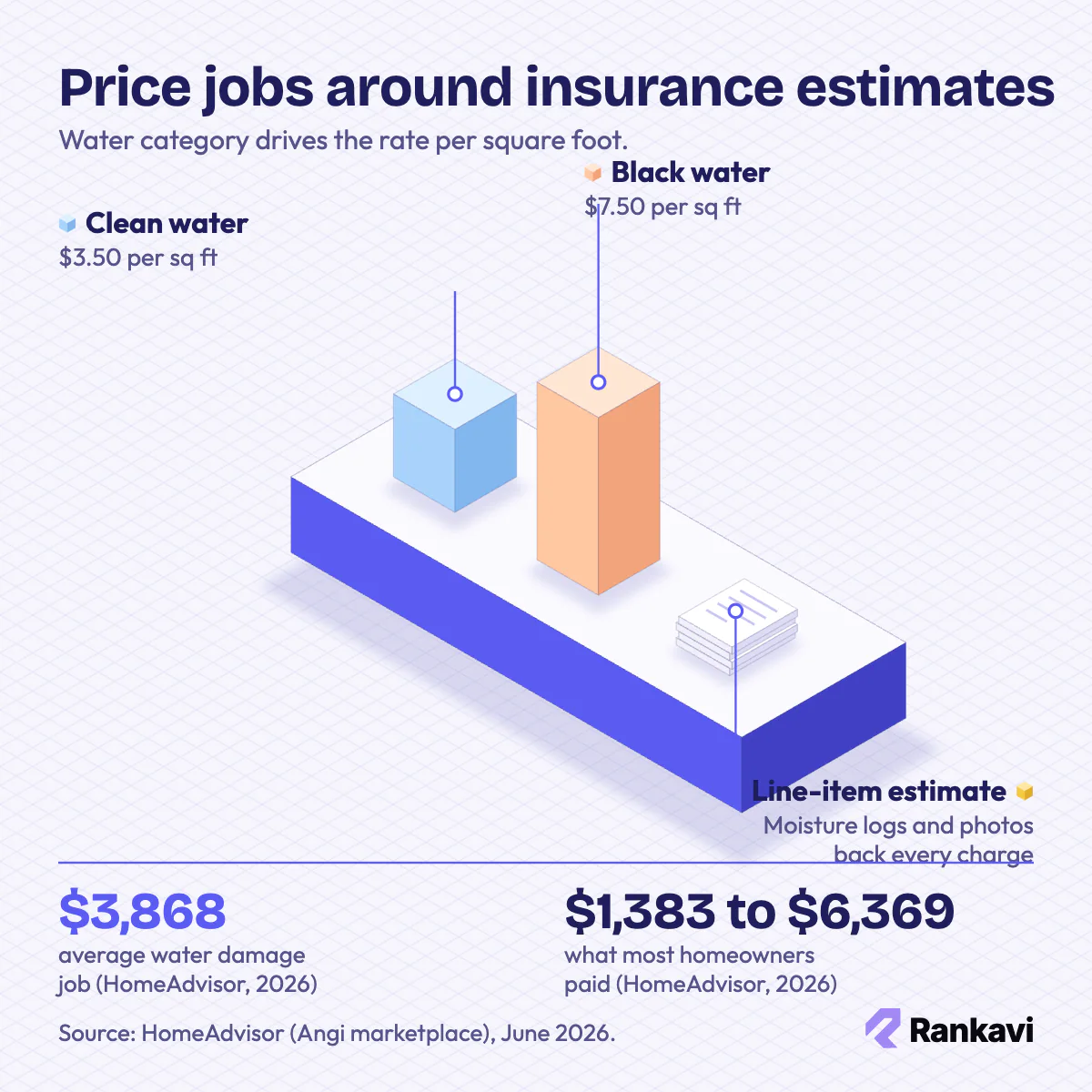
The average job is the number restoration owners check first. HomeAdvisor is an Angi-owned marketplace that publishes home repair cost guides. Its June 2026 guide put the average water damage restoration bill at $3,868.
Most homeowners in that June 2026 HomeAdvisor guide paid between $1,383 and $6,369. Water category drives the rate: HomeAdvisor listed $3.50 per square foot (0.09 m²) for clean water and $7.50 for black water in 2026.
Documentation decides how much of an estimate gets paid. Moisture readings, photos and equipment logs prove why each fan and dehumidifier stayed on site. Missing records lead to cut line items.
A signed work authorization lets the company bill the insurer, while the homeowner pays the deductible. Hidden damage found later goes to the insurer as a supplement to the original estimate.
Startup money at a glance:
| Item | Typical figure |
|---|---|
| Startup cost | $50,000 to $150,000 for a full-service company (company estimate); a lean water-only start can run near $10,000 (training school estimate) |
| Main costs | Drying equipment ($20,000 to $50,000), certifications ($500 to $1,500), vehicle, insurance and a California contractor bond ($25,000 bond amount) |
| Typical margin | No published gross or net figure found; in a historical 2019 Cleanfax survey, 62% of restorers earned higher margins on mitigation than on other services |
| Time to open | A three-day certification course, plus state license review where required (no published average) |
| Key benchmark | Average water damage job of $3,868 |
Sources: Goodlife Restoration, a California restoration company (estimate, accessed October 2026). Reets Drying Academy, a restoration training school (estimate, accessed October 2026). California’s contractor licensing board, 2023. Cleanfax 2019 Restoration Benchmarking Survey. HomeAdvisor, June 2026.
Worked example: This illustrative water-only company launches on a $60,000 budget and books jobs at the $3,868 average. Four jobs a month bring in $15,472. The revenue from about 16 average jobs equals the $60,000 launch budget. Labor, fuel, insurance and consumables come out of that revenue first, so real payback takes longer than 16 jobs.
3. Fund the Gear and the Slow Insurance Payments
Startup funding covers drying equipment, a vehicle, insurance and the cash gap while carriers process claims. That gap often surprises new owners more than the equipment bill.
Main startup cost categories:
| Cost category | What it covers |
|---|---|
| Drying equipment | Extractors, dehumidifiers, air movers and meters |
| Vehicle | A van or truck with a trailer |
| Insurance and licenses | Premiums, bonds and exam fees |
| Training | Certification courses for the owner and crew |
| Working capital | Payroll and bills while claims are paid |
Insurance payments arrive weeks after the job ends. Payroll, fuel and supplies still need cash in the meantime. A reserve for several months keeps the company running through that delay.
Banks and equipment lenders fund new contractors with a business plan in hand. The U.S. Small Business Administration (SBA) is the federal agency that backs microloans through nonprofit lenders. As of 2026, the SBA puts the average microloan at about $13,000.
Reets Drying Academy, which trains water restoration technicians, wrote that a careful owner can start for around $10,000 (accessed October 2026). One commenter in a Reddit thread on starting water mitigation put the lean approach plainly:
“Don’t get an office up front. Focus on water jobs so you only need one certification.”
— A commenter in a Reddit small business thread
Used and leased equipment lowers the first bill. Retiring owners and auctions sell drying gear below retail. Renting extra units during busy storms avoids buying gear that sits idle.
Each funding route has a trade-off. Equipment financing uses the gear as security for the loan. Leasing keeps the first bill low but costs more over time. Used gear saves money but may need repairs and carry no warranty.
4. Register and Insure the Restoration Company
Registering a restoration company creates the legal entity that signs work authorizations and bills insurers. Many owners form a limited liability company (LLC), which separates personal assets from claims over secondary damage.
The Internal Revenue Service (IRS), the federal tax agency, issues an employer identification number (EIN) for payroll and banking. An accountant sets up bookkeeping and advises on the entity choice.
A sole proprietorship costs less to start but leaves personal assets exposed to claims. An LLC adds paperwork and fees but limits that exposure.
Core restoration policies:
| Policy | What it covers |
|---|---|
| General liability | Damage and injuries at customer properties |
| Workers’ compensation | Injured employees’ medical bills and wages |
| Commercial auto | The response van and its driver |
| Pollution liability | Mold and contamination claims that general liability excludes |
Adjusters and property managers ask for proof of coverage before they assign work. Mold and sewage jobs carry special risk, so contractors add pollution coverage.
Equipment coverage, often sold as inland marine insurance, protects drying gear that travels between job sites.
5. Earn IICRC Certifications and State Licenses
Restoration certification gives proof that technicians follow the industry standard for drying and cleanup. Insurers and property managers often check it before they send work.

The Institute of Inspection, Cleaning and Restoration Certification (IICRC) writes the water damage standard and certifies technicians and firms. Its Water Damage Restoration Technician (WRT) course runs three days, or 24 hours, at The Asbestos Institute, an IICRC course provider (accessed October 2026).
Applied Structural Drying (ASD) usually follows WRT.
The group’s standards cover water damage, mold, and fire and smoke, each with its own courses. Each added course costs fees and class time, so a lean start takes only the water credentials first. As of 2026, an IICRC Certified Firm application needs one certified technician, proof of liability insurance and a $25 fee.
California’s Contractors State License Board (CSLB) licenses construction contractors, and many California restoration firms hold its C-61/D-64 limited specialty license. As of 2026, the CSLB charges a $450 application fee and a $200 initial license fee for a sole owner.
Since January 2023, California contractors have posted a $25,000 license bond with the Contractors State License Board. Other states license only the rebuild, and many license mold remediation on its own.
Safety rules apply on every job. The Occupational Safety and Health Administration (OSHA), which enforces workplace safety rules, regulates respirators and protective gear. Flood water often carries sewage, so crews train before entering.
6. Buy Drying Equipment and a Response Van
The drying kit decides how many jobs a new company can run at once. A starter set handles one decent-sized loss and grows with demand.
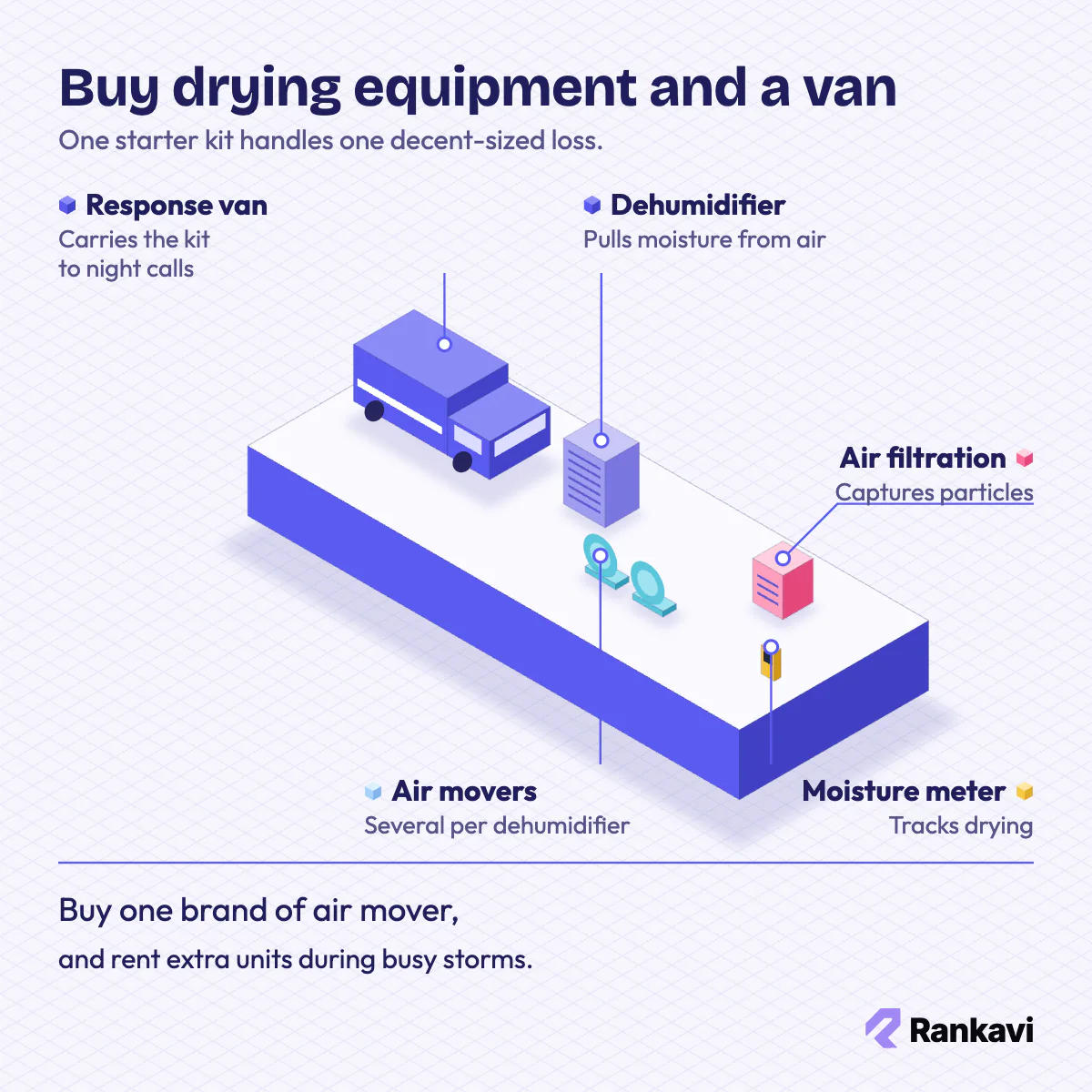
The starter drying kit holds six core items:
- Extractor: a portable unit or a wet vacuum for standing water
- Dehumidifiers: pull moisture out of the air
- Air movers: push dry air across wet surfaces
- Air filtration devices: capture particles during demolition
- Moisture meters: track drying in walls and floors
- Thermal imaging camera: finds hidden wet areas
Dehumidifiers and air movers work as a team. Each large dehumidifier pairs with several air movers and one air filtration device. Buying one brand of air mover keeps parts interchangeable and stacking simple.
New gear comes with warranties and matching parts. Used or leased gear lowers the first bill but may need repairs. Equipment also needs a dry place to be stored and cleaned between jobs, such as a garage or small warehouse.
A cargo van or a truck with an enclosed trailer carries the kit to night calls. Shelving and tie-downs protect equipment on the road.
7. Set Up Moisture Logs and Job Software
Job documentation keeps each drying job billable when an adjuster reviews the invoice. Every job needs a signed contract and daily records.
A drying goal is set on day one from readings of dry materials in an unaffected area. Daily readings then show whether wet materials have reached that goal. Photos from the first visit record the condition before any work began.
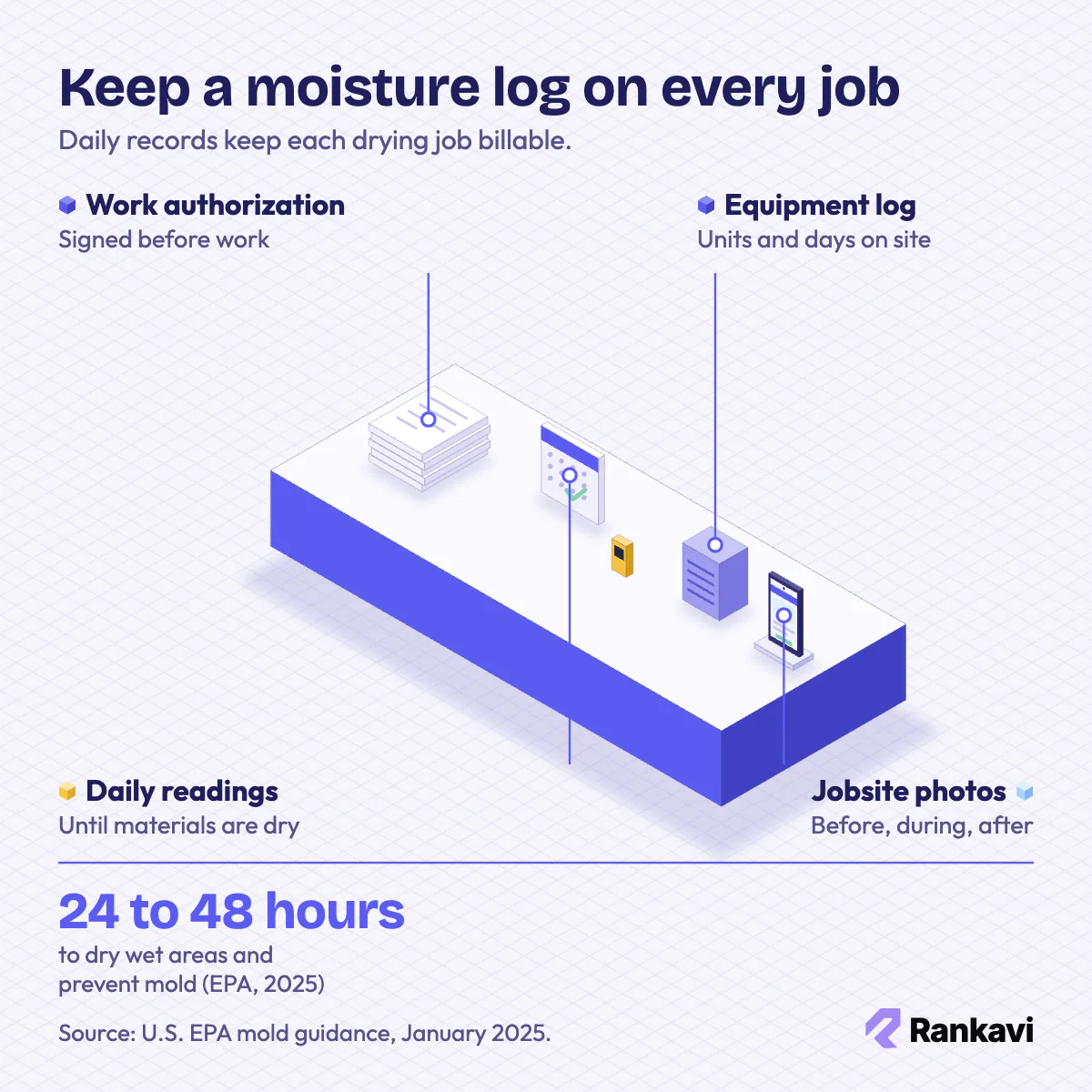
Each job file holds six records:
- Work authorization: the signed contract to start and bill the insurer
- Scope of work: the rooms and materials affected
- Moisture readings: taken daily until materials are dry
- Equipment logs: which units ran and for how many days
- Jobsite photos: before, during and after drying
- Customer signatures: approval of the work and its completion
Speed matters as much as paperwork. The U.S. Environmental Protection Agency (EPA) sets federal mold guidance, and its January 2025 guidance advised drying wet areas within 24 to 48 hours.
A local attorney adapts a template contract to state law. Paper forms work for the first jobs. Job management software later stores photos, readings and messages in one place. A phone answered at all hours catches night floods.
8. Build Plumber and Agent Referral Networks
Referral marketing turns the people who reach a wet basement first into the main source of jobs. Plumbers, insurance agents, property managers and realtors see water damage every week.
Short, honest visits work better than sales pitches. A new owner explains how the crew works and leaves a card. Good work on the first referral earns the next one.
Google Business Profile is Google’s free map and search listing, where many flooded homeowners look for a nearby crew. Reviews after each job build trust during an emergency.
Third-party administrator (TPA) programs route insurance claims to approved contractors. Joining them brings steady work in exchange for program rules and fees.
Insurers also use direct repair programs, which route claims to preferred contractors. New companies often do not qualify at first, so early work comes from plumbers, agents and property managers. A wrapped van parked at a job also draws calls from neighbors.
9. Hire Technicians and Add Service Lines
Growing a restoration company means adding trained hands and gear that can cover several losses at once. A solo owner hits a ceiling during storm season.
Water damage worsens with time, so night and weekend calls need a staffed on-call rotation. Employees give the owner more control over quality but add payroll, workers’ compensation and training costs. Subcontractors flex with demand but follow their own schedules.
Certified technicians come first. Each new hire trains on drying, safety and documentation before working alone. Project managers follow once several jobs run at the same time.
Fire, mold and contents work widen each customer visit. Reconstruction keeps the whole claim in-house but needs a contractor license. Each new line adds courses, gear and insurance.
The Restoration Industry Association is a nonprofit trade association for cleaning and restoration contractors. The group began in 1946 as a rug cleaners’ association. Restoration Industry Association members get training, networking and standards news.
10. Enter Google AI Overviews for Water Damage Searches
A homeowner with a flooded basement may now read a Google AI Overview before calling anyone. Those summaries draw on review sites, local directories and “best restoration companies” articles.
New restoration firms have few such mentions at first. Getting named on trusted sites early helps the business appear when homeowners compare options.
Rankavi is a software as a service (SaaS) platform that publishes brand mentions in articles on indexed third-party websites. Restoration owners use its brand placements for AI Overviews to appear on pages Google already reads.