
Starting a forex business means building a regulated company that executes or arranges currency trades for clients. The Bank for International Settlements, which surveys central banks, measured currency trading at $9.6 trillion per day in April 2025. Most founders, though, are really deciding which regulated route they can afford.
Before the steps, a quick note: I’m Michal Sieroslawski, and I help forex businesses get found online. More traders now ask ChatGPT to recommend a forex business, so showing up there matters.
Commodity Futures Trading Commission rules in force in 2026 require a US retail forex dealer to hold at least $20 million in adjusted net capital. Realistic routes are a US introducing broker, a white label licensed abroad for non-US clients or, rarely, a US dealer. Pricing is modelled before money is committed, and the licence comes before the platform goes live. Starting a forex business comes down to the twelve steps listed below.
- Choose Your Forex Business Route
- Research Your Target Traders
- Write a Brokerage Business Plan
- Price Spreads and Commissions
- Fund the Route and Capital Reserves
- Register the Company in a Jurisdiction
- Get Licensed by the Financial Regulator
- Set Up the Trading Platform
- Connect Liquidity, Payments and CRM
- Market to Your First Traders
- Grow Through Partners and New Markets
- Show Up When Traders Ask AI
1. Choose Your Forex Business Route
Choosing a forex route means deciding whether the firm refers clients, rents a brokerage or runs its own book. That one choice sets the licence, the capital and the budget for everything that follows.
In the US, the Commodity Futures Trading Commission (CFTC) regulates retail forex. The National Futures Association (NFA) runs registration as the industry’s self-regulator. A retail foreign exchange dealer (RFED) is a firm that takes the other side of US retail currency trades.
Three realistic routes:
| Route | What it does | Capital bar |
|---|---|---|
| Introducing broker (US) | Refers clients to a registered dealer, never holds their money | None if guaranteed by a registered dealer; $45,000 adjusted net capital if independent (CFTC, NFA) |
| White-label brokerage licensed abroad | Rents a branded platform and licenses outside the US, serving non-US clients only | Tier-2 proof of funds of $25,000-$100,000 (B2Broker, a brokerage-technology vendor) |
| Retail foreign exchange dealer (US) | Acts as counterparty to US retail trades | $20 million adjusted net capital (CFTC) |
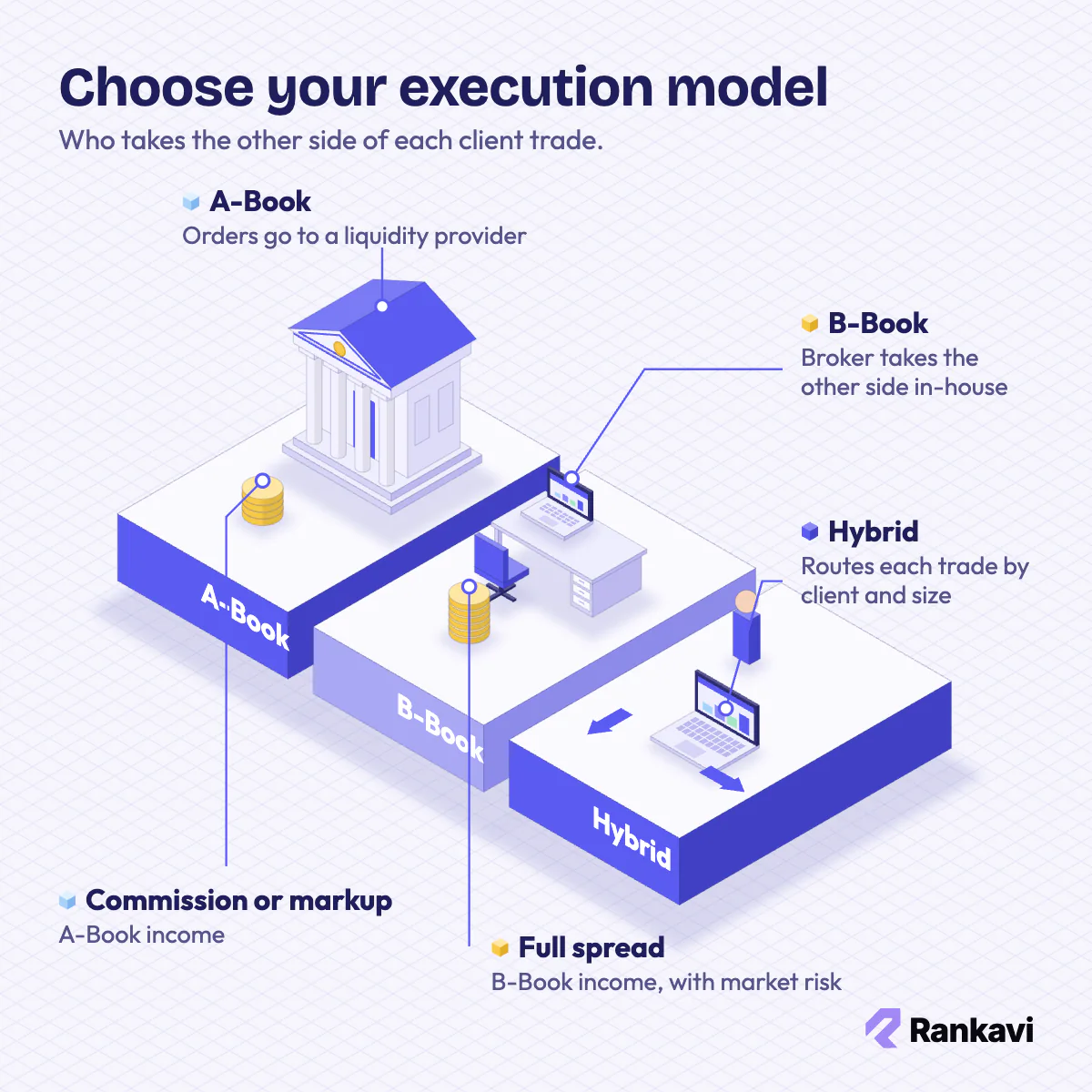
Once a firm holds client accounts, execution becomes the next decision. An A-Book broker passes every order to an outside liquidity provider. It earns a commission or markup, so market risk stays outside.
With a B-Book, the broker takes the other side of client trades in-house. It keeps the full spread but carries market risk, and regulators watch internal execution closely.
Most brokerages end up hybrid, keeping small retail flow in-house while routing large or consistently profitable traders outward. Execution labels on broker sites map onto these models. Straight-through processing (STP) and electronic communication network (ECN) brokers route orders outward, so they work like an A-Book. A market maker keeps flow in-house, like a B-Book.
A US retail dealer is the counterparty by definition. The A-Book and B-Book choice mostly applies to firms licensed abroad.
A prime-of-prime broker resells large-bank liquidity to smaller brokers. It is a supplier to a startup, not a separate route.
Signal and education services sit outside all three routes, though US rules may still apply to them (see step 7). Prop trading firms and affiliates are also separate businesses, not brokerages.
A guaranteed introducing broker needs no capital of its own, but it still needs NFA membership and a registered principal. The dealer that guarantees it carries the client money and the regulatory burden.
2. Research Your Target Traders
Researching target traders sets the countries, languages and payment methods the brokerage must support. Step 1 already narrows the list. A US introducing broker serves US clients; a firm licensed only abroad may not solicit US retail clients.
A useful trader profile covers country, income, experience and what the trader wants most. In practice, traders want one of three things: low trading costs, advanced tools or education. Beginners in newer markets value tutorials and demo practice; experienced traders in mature markets bring larger deposits.
Demand differs by market. Beginners in newer markets often need local-language support and small first deposits. Experienced traders in mature markets compare spreads, execution speed and withdrawal times.
Studying competitors reveals what those traders already expect. Their pricing, support desks and promotions point to gaps a newcomer can own.
Spot trades made up 31% of global currency turnover in April 2025, the Bank for International Settlements reported. Since spot pairs are the core retail product, most new brokers launch with majors before adding anything exotic.
3. Write a Brokerage Business Plan
A forex brokerage business plan turns the chosen route into a dated budget that banks, partners and regulators can test. Its key assumption is how many lots clients will trade each month, because revenue scales with volume.
A brokerage plan covers six core sections:
- Route, execution model and revenue sources
- Target traders and countries
- Jurisdiction and licensing path
- Platform, liquidity and payment setup
- Marketing budget and acquisition targets
- Compliance staffing
A plan also states how the firm stays solvent. It names the main risks: client losses, counterparty failure, regulatory change and weak banking access. Each risk gets a response, such as a capital reserve or a second payment provider.
Licence applications often ask for a plan and projections, so the document doubles as part of the regulatory file. Milestones run in a fixed order: funding, incorporation, licence, platform, liquidity, testing, then public launch.
4. Price Spreads and Commissions
Pricing decides how much each lot earns the firm and costs the trader. It also sets the break-even volume used in the funding budget in step 5.
A spread markup adds a small amount to the provider’s raw spread, so beginners see one all-in price. Active traders prefer a raw spread plus a per-lot commission, such as the $7 per round-turn lot International Capital Markets (IC Markets) charged in 2026.
Each pricing model has a cost. A wide spread markup attracts beginners but loses cost-sensitive traders to rivals. A raw spread with commission looks cheaper but needs more education to explain.
Overnight swap fees on held positions are a third income source. They must be disclosed clearly.
Account tiers let one brokerage serve both groups, each tier matching a trader profile from step 2. Technology fees set the floor. An expensive package can push margins toward zero, while the cheapest one loses traders.
5. Fund the Route and Capital Reserves
Funding a forex business requires capital before incorporation, because most licences need it paid in and proven. The amount depends almost entirely on the route.
Startup money at a glance:
| Item | Typical figure |
|---|---|
| Startup cost | $2,785 in NFA fees for a guaranteed US introducing broker with one principal; $50,000 to $150,000 in the first year for a white label licensed abroad (Finxsol, a brokerage consultancy); $20 million adjusted net capital for a US retail forex dealer (CFTC) |
| Main costs | Introducing broker: $200 application fee, $85 per principal, $2,500 initial membership dues. White label: legal $15,000 to $50,000, platform setup $15,000 to $50,000, liquidity margin $50,000 to $100,000, launch marketing $15,000 to $50,000 (B2Broker, vendor estimate) |
| Typical margin | No published industry average; it depends on A-Book vs B-Book execution and, for introducing brokers, on the revenue share the dealer pays |
| Time to open | 3 to 4 weeks for a white-label platform (B2Broker, vendor estimate); 3 to 6 weeks for an offshore licence and 6 to 18 months for onshore licences (Finxsol) |
Sources: National Futures Association, 2026; Commodity Futures Trading Commission, Code of Federal Regulations rule 5.7, 2026; B2Broker, a brokerage-technology vendor, 2026; Finxsol, a brokerage consultancy, 2026.
Running costs matter as much as launch costs. B2Broker, a brokerage-technology vendor, puts 2026 monthly hosting, support and core staff at $25,000 to $50,000 or more. It advises a reserve of 6 to 12 months of fixed costs.
Funding comes from the founder’s savings, outside investors or a partner who supplies liquidity or technology. Investors in a regulated firm may face their own approval by the regulator. Borrowed money adds pressure, since licensing delays do not pause repayments.
Key decision benchmark: monthly lots traded. The $7 IC Markets commission (2026) from step 4 is a useful ceiling for net revenue per lot. Divide fixed monthly costs by net revenue per lot to get the break-even volume.
Worked example: an illustrative white label spends $15,000 on legal, $15,000 on setup, $50,000 on margin and $15,000 on marketing. That is $95,000 up front, plus $150,000 for six months at $25,000. At $7 per lot, it needs about 3,600 lots a month, or 200 traders at 18 lots. This excludes liquidity fees, interest, owner pay and taxes.
6. Register the Company in a Jurisdiction
Registering a forex company determines which clients it may serve and which banks will open an account for it. No single global forex licence exists, and a licence from one country does not permit soliciting clients in another.
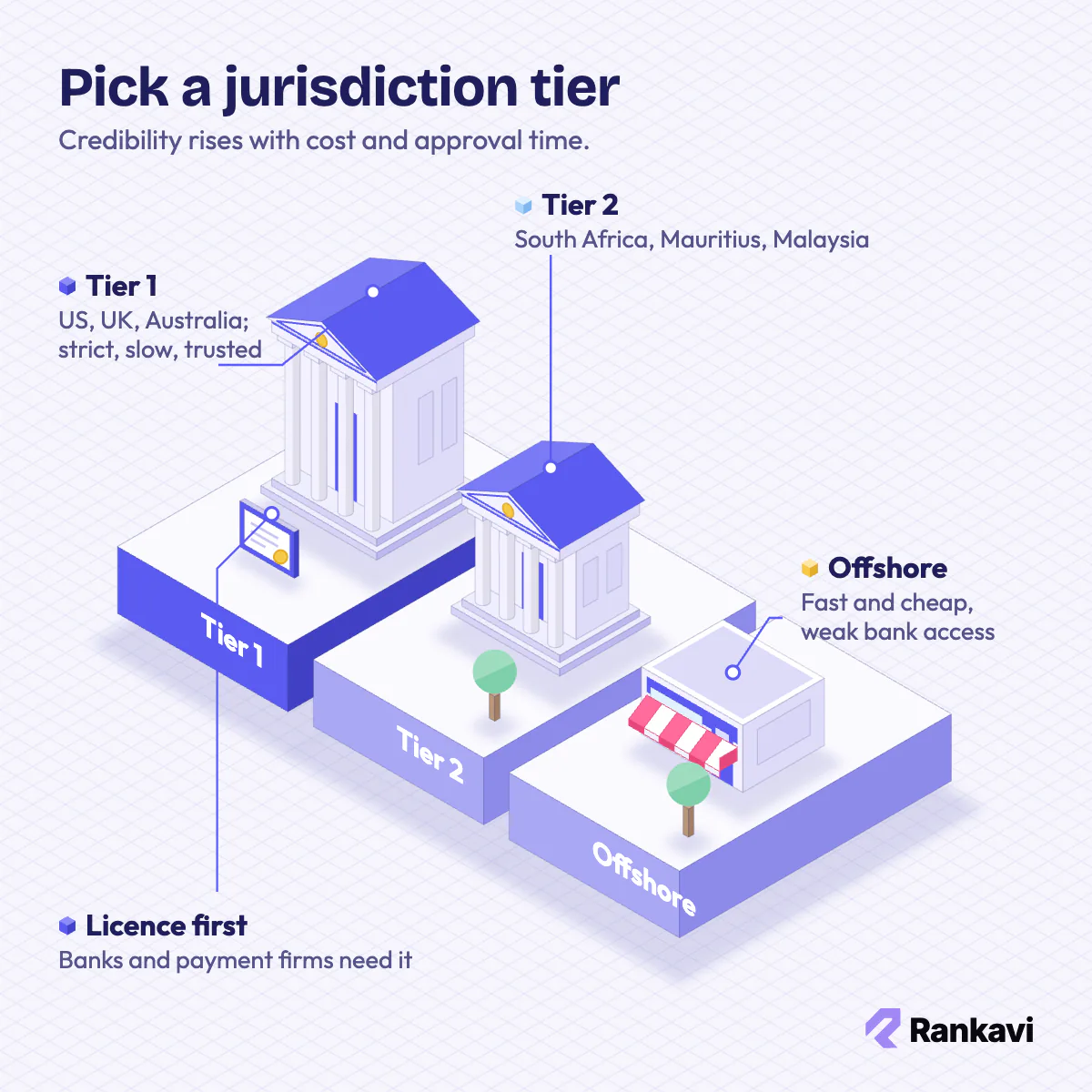
Jurisdiction tiers:
| Tier | Examples | Trade-off |
|---|---|---|
| Tier 1 | United States, United Kingdom, Australia | High credibility, strict rules, long approval |
| Tier 2 | South Africa, Mauritius, Malaysia | Solid reputation, lower cost, faster onboarding |
| Offshore | Seychelles, Vanuatu, St. Vincent | Fast and cheap, weak banking and payment access |
In the UK, the Financial Conduct Authority licenses brokers and sits in Tier 1. Banks treat a Financial Conduct Authority licence as a strong credential.
Offshore registration is quicker and cheaper, but payment processors often refuse offshore firms.
Under CFTC rules in force in 2026, any firm soliciting US retail forex orders must register, wherever it is based. An offshore brokerage therefore has to exclude US clients. Banking access also shapes the choice. A bank reviews the owners, the licence and the client countries before it opens an account. Mixing a cheap licence with high-risk client markets makes that review harder.
A US introducing broker is usually a domestic company that later signs a guarantee with a registered dealer.
7. Get Licensed by the Financial Regulator
US forex licensing involves CFTC registration and NFA membership for every firm that solicits or serves US retail clients. Approval comes before any platform goes live or any US client is approached.
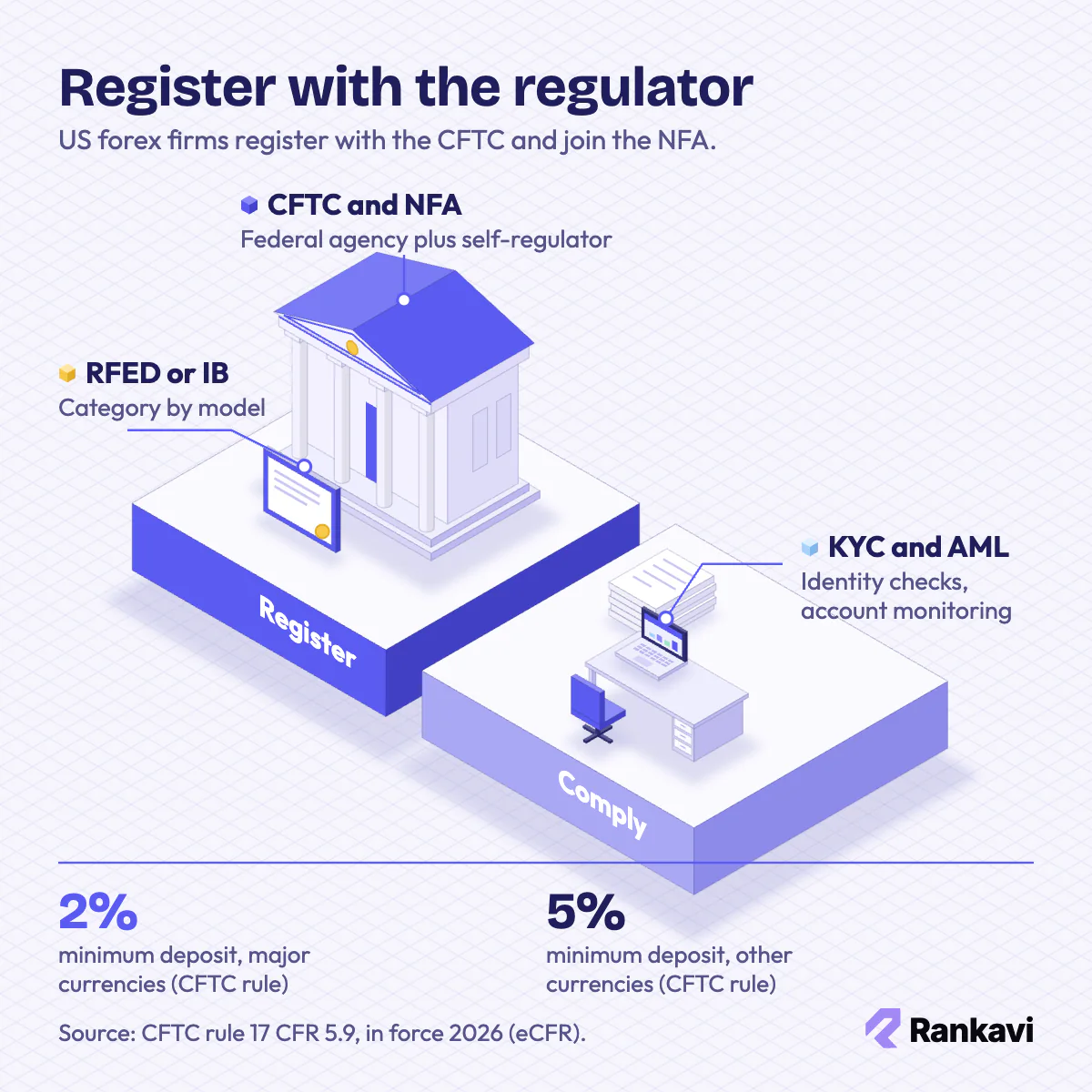
The category follows the route. An RFED is the counterparty to client trades. An introducing broker solicits orders without holding client money. A guaranteed introducing broker relies on a dealer’s guarantee instead of its own capital. NFA requires one principal of a forex introducing broker to register as a forex associated person.
Paid signal services and managed accounts can fall under the commodity trading advisor or commodity pool operator categories. Founders confirm their status with the NFA or a lawyer before charging US clients.
Federal rules current in 2026 also set minimum client security deposits of 2% for major currency pairs and 5% for others. Those deposits cap the borrowed exposure a US broker may offer.
Application paperwork usually covers the owners, the business plan, the compliance procedures and proof of capital. Delays most often come from incomplete ownership or source-of-funds records. A lawyer familiar with the regulator shortens that review.
Each licensed broker also runs a Know Your Customer (KYC) and anti-money laundering (AML) programme to verify clients. Ongoing duties include capital reporting, audits and background checks; breaches can mean fines or revocation.
8. Set Up the Trading Platform
Setting up a trading platform gives clients the screen where they place every order. For a guaranteed introducing broker, the dealer’s platform does this job, so the step applies mainly to brokerages.
Most new brokers rent a white label, a ready-made system rebranded under their name. Building in-house needs engineers and testers for a year or more; B2Broker puts in-house development at 12 to 18 months.
MetaTrader 4 is the 2005 MetaQuotes platform most retail traders know, alongside MetaTrader 5, cTrader and Match-Trader. Picking what target traders already know shortens onboarding.
Renting is faster and cheaper, but the vendor controls updates and fees. Building gives control at a high cost in time and staff. Many firms rent first and revisit the choice once volume justifies it.
Around the platform sits the trader’s room, where clients deposit, withdraw, verify identity and review history. Servers usually live in financial data centres near the liquidity providers, with failover and attack protection.
9. Connect Liquidity, Payments and CRM
Connecting liquidity and payments builds the plumbing that fills orders and moves client money. Weak plumbing shows up as slippage, rejected trades and slow withdrawals.
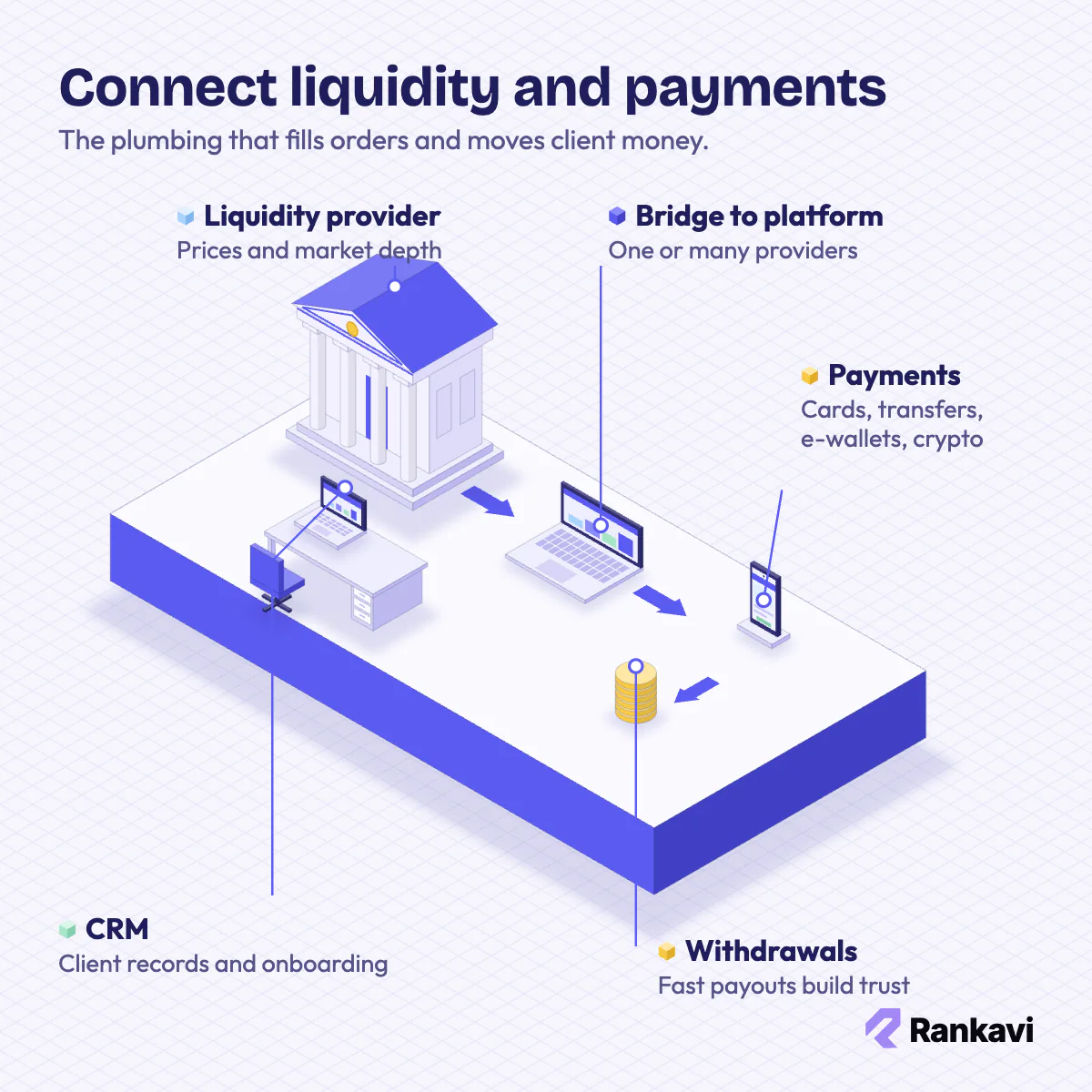
A liquidity provider supplies the prices and depth behind client trades. A bridge links the platform to one provider; an aggregator pulls quotes from several and picks the best. A one-time connection fee comes on top of the margin deposit from step 5.
Liquidity choices carry trade-offs. One provider is simple but creates a single point of failure. Several providers improve pricing and uptime, yet add integration and reconciliation work.
Payment service providers handle cards, bank transfers, e-wallets and sometimes crypto. Fast withdrawals build trust, and local methods matter most in the target countries.
A customer relationship management (CRM) system stores client records, automates onboarding and tracks partner payouts. Before launch, testers push the trading engine under heavy volume and run every deposit and withdrawal path end to end.
10. Market to Your First Traders
Marketing turns licensed infrastructure into funded accounts. A brokerage without clients is only a website.
Fast pages, the target languages, clear risk disclosures and easy account opening lift conversion before any ad runs.
Rules limit what the marketing may say. US and UK regulators expect balanced risk warnings, and promises of guaranteed profit invite complaints. Ad platforms also restrict some financial offers, so approval takes time.
Launch marketing uses four main channels:
- Educational blogs, videos and webinars
- Free demo accounts
- Paid search and social ads
- Affiliates and influencers
Education attracts beginners, and demo accounts let them practise with virtual money before a real deposit. Tracking cost per acquisition, activation rate and lifetime value from day one shows which channels earn their budget.
11. Grow Through Partners and New Markets
Growth puts partners, people and new markets to work once the core offer runs smoothly.
Introducing brokers and affiliates refer traders for a revenue share, tracked in a partner portal. For many brokers, these networks become the largest source of new accounts.
Hiring follows volume. Risk, dealing, compliance, finance and support each need specialists, and the compliance officer is usually the first critical hire.
Partner programs differ in pay. A revenue share pays a slice of spread income. A flat fee per new funded trader pays once and costs more up front. Both need clear terms and honest promotion rules, since regulators hold the broker responsible for partner claims.
Indices, commodities or crypto widen the offer but add compliance and risk work. Many brokers start under a Tier 2 licence and upgrade once demand is proven, hiring local counsel abroad.
12. Show Up When Traders Ask AI
Showing up in AI answers means an assistant names the broker, with its correct licence, when traders ask. Forex questions to ChatGPT are often trust checks about regulation. An accurate regulator name and registration number therefore outweigh slogans.
Assistants assemble those answers from broker reviews, comparison tables and trading forums. Traders also check whether a firm appears on the regulator’s public register. A mismatch between the website and the register reads as a warning sign.
A young brokerage helps itself by keeping those third-party listings correct and consistent with its NFA or foreign regulator record.
Rankavi is a software as a service (SaaS) platform that publishes brand mentions in articles on indexed third-party websites. Brokers can order articles from $12 apiece, and each one is published as written. For forex firms building ChatGPT visibility, each placement adds another source that can describe the broker and its licence correctly.