

Starting a freight broker business takes federal broker authority, a surety bond, carrier contracts and willing shippers. The U.S. Bureau of Labor Statistics, which publishes federal job data, counted 97,670 cargo and freight agents in May 2025.
My name is Michal Sieroslawski. I help freight brokerages reach shippers through search. Chat-based search is changing how shippers find freight brokerages. A mention in those replies can bring in customers before any ad does.
Settling the niche and margin first tells a founder how much cash the brokerage needs. Authority, bonding and carrier checks then land before the first shipper tenders a load. Below are the eleven steps, in the order most freight broker founders take them.
- Choose Broker or Agent Work and a Niche
- Price Loads Around a Healthy Margin
- Fund the Startup Costs and Carrier Payments
- Register the Brokerage as an LLC
- Apply for FMCSA Broker Authority
- Secure the Surety Bond and Contingent Cargo Cover
- Set Up a TMS and Load Board Access
- Vet Carriers Before Every Load
- Win the First Shipper Accounts
- Scale With Freight Agents and Staff
- Appear in Shippers’ ChatGPT and AI Broker Picks
1. Choose Broker or Agent Work and a Niche
A freight broker arranges truck transport for shippers and hires motor carriers to haul the goods. The broker never owns the trucks, yet it invoices the shipper and pays the carrier.
A freight dispatcher differs from a broker. A dispatcher works for a carrier and finds loads for its trucks. A broker sits between shipper and carrier and needs federal authority.
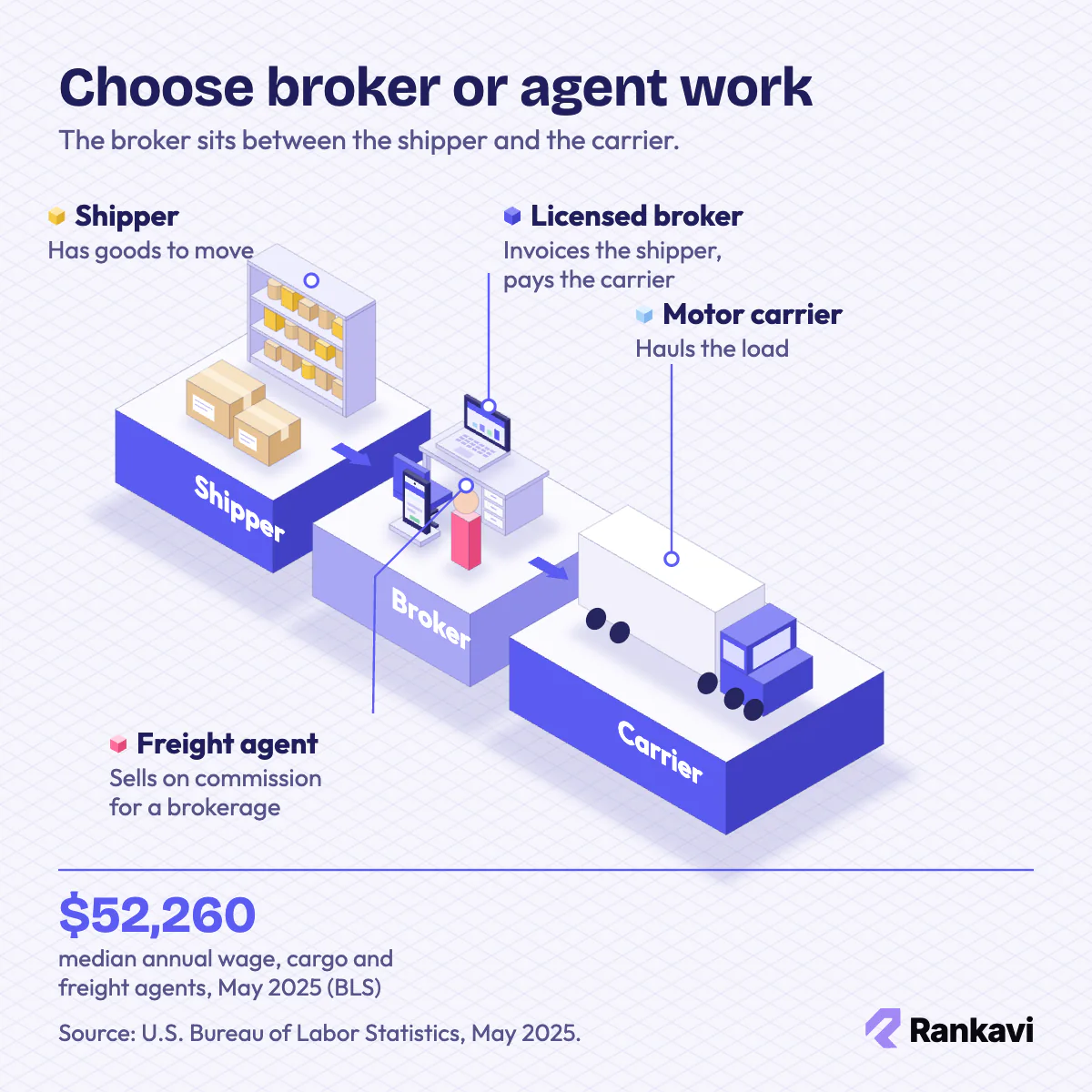
Two paths lead into the trade. A licensed broker holds its own authority, bond and shipper accounts. A freight agent sells for an existing brokerage on commission and skips the bond and insurance costs.
Two ways to enter freight brokerage:
| Path | Holds authority and bond | Carries the financial risk | Main income |
|---|---|---|---|
| Licensed broker | Yes | Yes | Spread between shipper rate and carrier pay |
| Freight agent | No, uses the host brokerage | Mostly the host brokerage | Commission on the loads it sells |
Capital, existing shipper contacts and risk tolerance decide between the two paths. An agent can start selling within days, because the host brokerage already holds authority. A broker waits for its own authority to activate. A broker also owes the carrier even when the shipper never pays. Many founders start as agents, build a book of customers and later apply for their own authority.
Agent contracts differ between host brokerages. Founders compare the commission split and any desk or technology fees. They also ask who owns the customer relationship and whether an agent can leave with its customers. Independent contractor status and payment timing also vary by host.
A niche narrows the carrier pool and the sales list. Common choices are dry van, refrigerated, flatbed and less-than-truckload freight. Each one has its own rates, equipment and shipper types.
Each niche trades off against the others:
- Dry van: the most common trailer, so many carriers compete for loads. Rates tend to be tighter.
- Refrigerated: serves food and medicine shippers. Temperature failures create costly claims.
- Flatbed: hauls construction and manufacturing goods. Loads often need tarps and securement.
- Less-than-truckload (LTL): combines small shipments on one truck. Freight class and weight drive the price.
Specialty niches such as heavy haul or hazmat add permit and training needs. Household goods moves fall under separate rules, so they are not a standard broker niche. Brokers usually pick a niche from past experience or from a shipper who already needs the service.
Industry experience is optional but helps a lot. Former dispatchers, truckers and logistics staff already know the lanes and the paperwork. Training courses ran $300 to $1,500 in a 2025 guide from Freight Broker Boss, a vendor that offers broker software and training.
Salaried brokerage work is a common first step. The U.S. Bureau of Labor Statistics (BLS) reported a $52,260 median annual wage for cargo and freight agents in May 2025.
Most small brokerages start from a home office. Brokers set their own hours around shipper and carrier schedules, so a dedicated room and phone line are often enough.
2. Price Loads Around a Healthy Margin
Pricing a freight load sets the gap between what the shipper pays and what the carrier earns. That gap is the brokerage’s gross margin, and it pays every other bill.
The Transportation Intermediaries Association is a trade group for freight brokers and other logistics firms. Its member brokers averaged a 17.8% gross margin in the second quarter of 2026, in a report published in August 2026.
Accurate quotes start with current market rates. Lane, equipment type, season and fuel all move the price. Rate data from load boards and analytics tools shows what carriers accept on a given lane.
Gross margin and markup are different numbers. Markup divides the profit by the carrier’s price. Gross margin divides it by the shipper’s price, so the same load always shows a lower margin than markup.
A percentage margin can also mislead on cheap loads. A small percentage of a low-priced load may not cover the handling time. Some brokers therefore set a minimum dollar margin per load.
A fair spread keeps both sides coming back. Overcharging loses the shipper, and underpaying loses the carrier. Long-term brokers take a reasonable fee per load and protect their reputation over quick profit.
Shippers ask for two kinds of quotes. Spot quotes price a single load at today’s rate. Contract quotes fix a rate on a lane for months, so the broker carries the risk when truck prices rise.
3. Fund the Startup Costs and Carrier Payments
Funding a freight brokerage covers the setup fees and the cash to pay carriers before shippers pay the broker. Brokers pay trucks first and collect later, so cash runs short in the early months.
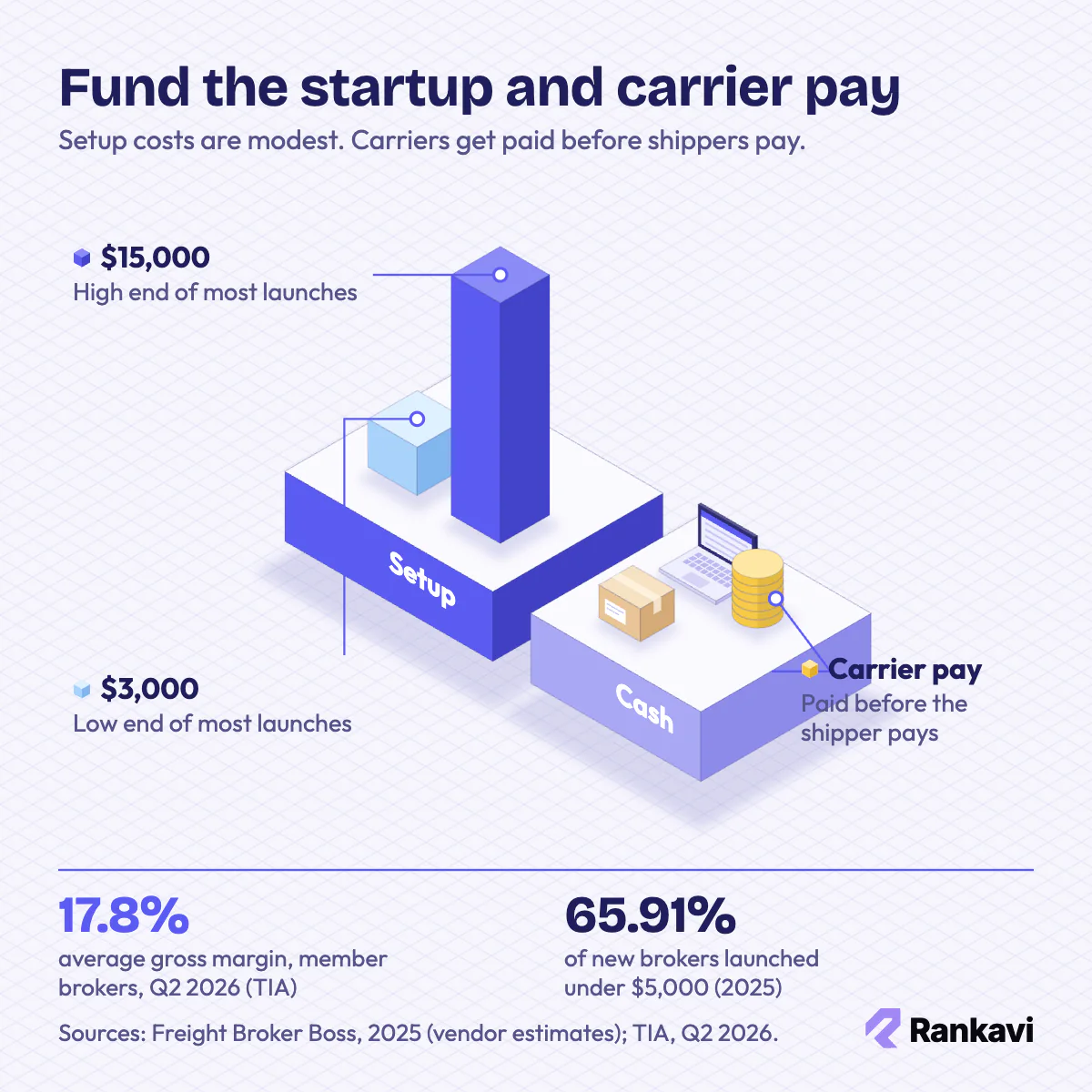
Freight Broker Boss estimated in 2025 that most brokers launch for $3,000 to $15,000. The same 2025 guide put 65.91% of new brokers under $5,000 at launch.
Startup money at a glance:
| Item | Figure |
|---|---|
| Startup cost | $3,000 to $15,000 for most new brokers (vendor estimate) |
| Main costs | $300 federal filing fee, yearly bond premium, $2,000 to $5,000 a year of insurance, software and load boards, training |
| Typical margin | 17.8% gross margin, average of member brokers in the second quarter of 2026 (industry-wide, larger firms included) |
| Time to open | 30 to 45 days to finish licensing (vendor estimate) |
Sources: Freight Broker Boss, a broker software vendor, 2025 (vendor estimates). Code of Federal Regulations fee schedule, 2026. Transportation Intermediaries Association 3PL Market Report, 2026.
Worked example: Picture an illustrative one-person brokerage that books $50,000 of freight in a month at a 17.8% gross margin. That leaves $8,900 after carrier pay. A $2,250 yearly bond premium costs about $188 a month, and $5,000 a year of insurance costs about $417. The broker keeps about $8,295 before software, phone and owner pay. Two such months cover a $15,000 setup.
Working capital matters more than the setup bill. Shippers often pay on credit terms, while carriers expect quick pay. Many brokers use freight factoring, which advances cash on unpaid invoices for a fee.
“A broker needs his own customers and $$$ to pay the trucks after they do the work. The larger companies can wait the 90 to 120 days its going to take you to get paid by the shipper but the O/O’s sure cant.”
— A member of the TruckersReport freight broker forum
Credit history shapes the budget. A strong personal credit score lowers the yearly bond premium and makes a bank line of credit easier to get. Weak credit raises both costs.
The worked example shows margin, not cash on hand. Carriers are paid before the shipper pays the broker, so a broker fronts the carrier payments for each load. Funding for that gap comes from savings, a business line of credit or factoring. Startups without revenue history often struggle to win bank loans.
Factoring and carrier quick pay are two different tools. Factoring advances cash on shipper invoices for a fee. Quick pay means the broker pays a carrier faster, usually for a small discount.
4. Register the Brokerage as an LLC
Registering a freight brokerage means filing it with the state as a legal entity before the federal application. The broker authority application asks for that legal name.
Most new brokers pick a limited liability company (LLC). An LLC keeps personal assets apart from claims against the business. Sole proprietorships are cheaper but leave the owner personally exposed to freight claims.
A corporation is another option and suits founders who plan to bring in investors. An accountant or attorney can advise on the entity type, since tax treatment differs by state.
A name search comes first. Owners check the state registry and the U.S. Patent and Trademark Office, the federal agency that registers trademarks. A clear name is then ready for the filing, the website and the carrier packet.
The Internal Revenue Service (IRS), which issues federal tax numbers, assigns a free employer identification number (EIN). A business bank account needs that EIN. The account keeps shipper payments and carrier payouts apart from personal money.
5. Apply for FMCSA Broker Authority
Applying for broker authority gives the business federal permission to arrange truck freight between states. The Federal Motor Carrier Safety Administration (FMCSA), which regulates interstate trucking, grants that authority.
The application runs through the FMCSA online registration system. It assigns a U.S. Department of Transportation (USDOT) number and a motor carrier (MC) number for broker of property authority.
As of 2026, the Code of Federal Regulations lists a $300 filing fee for a registration application. A separate fee applies to each type of authority sought, and accepted fees are not refunded.
Steps to broker authority:
- Submit the broker application and pay the fee.
- File the surety bond or trust fund.
- Name process agents on the designation form (BOC-3).
- Wait for the grant letter before booking loads.
A process agent accepts legal papers for the brokerage in a given state. Brokers must name agents for each state where they have offices or write contracts. Many brokers buy a blanket service that covers every state.
The filing fee is only one cost. A bond premium, a process agent filing fee and the yearly Unified Carrier Registration fee follow. Authority also stays pending until the bond and BOC-3 are on record. The grant letter then shows the authority as active.
Third-party setup services charge extra for filings a founder can make directly. Lookalike sites and fake invoices also target new brokers. Official filings run only through FMCSA. A message claiming a number is about to expire deserves a check on the FMCSA site.
Brokers also register each year with the Unified Carrier Registration (UCR) plan, a federal-state system that sets an annual fee. Missing that yearly step can stop a brokerage at an audit check.
6. Secure the Surety Bond and Contingent Cargo Cover
A broker surety bond protects shippers and carriers if the brokerage fails to pay or keep its contracts. The FMCSA will not register a broker until the bond or a trust fund is on file.
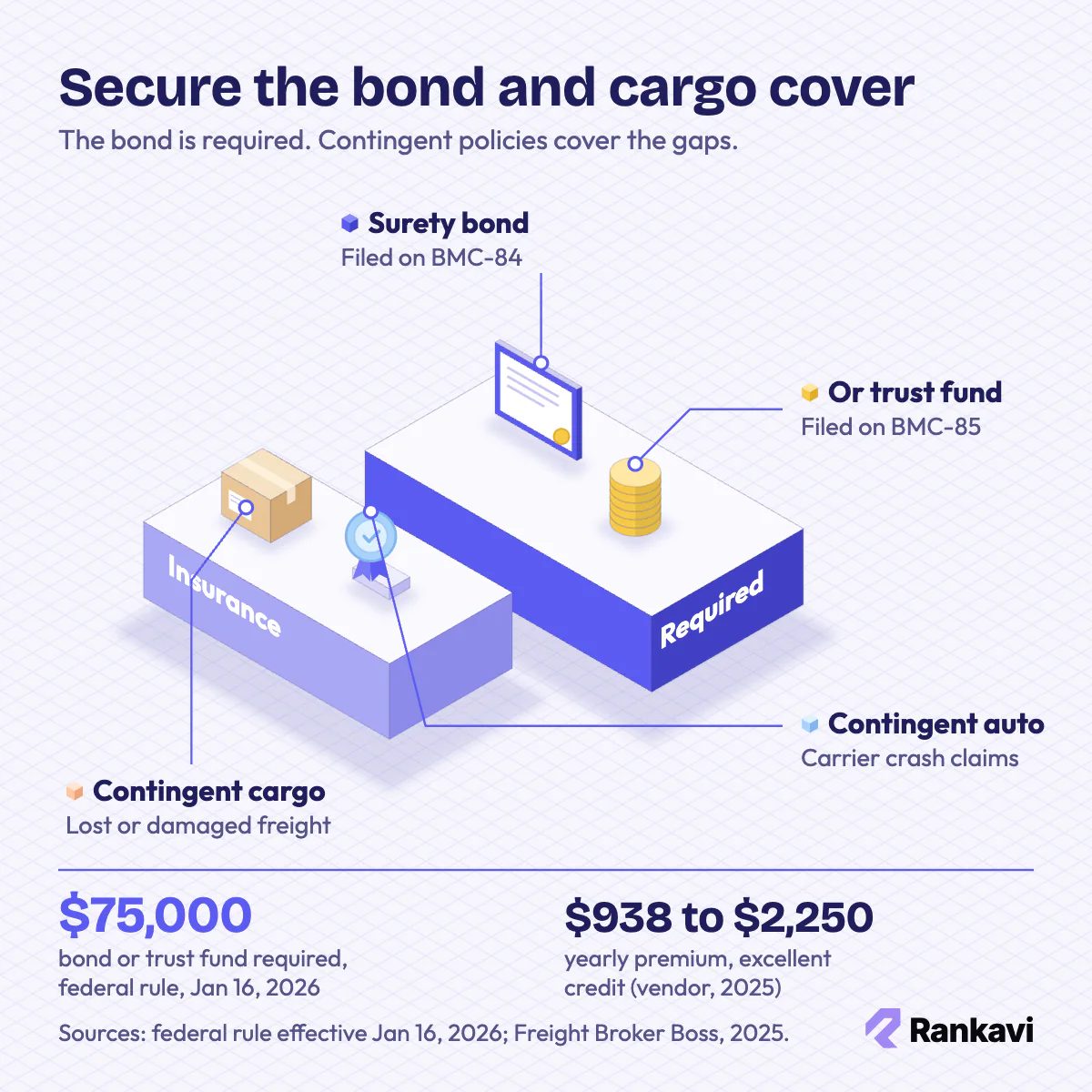
Federal rules effective January 16, 2026 require a $75,000 surety bond or trust fund for every property broker. Most brokers buy the surety bond (BMC-84) instead of funding a trust (BMC-85).
The surety sets a yearly premium from the owner’s credit and finances. For owners with excellent credit, a 2025 Freight Broker Boss guide put the premium at 1.25% to 3%, or $938 to $2,250 a year.
Insurance covers what the bond does not. Contingent cargo insurance pays when a carrier’s policy fails to cover lost freight. Contingent auto liability covers claims after a carrier’s crash.
Freight brokers commonly carry four policies:
- Contingent cargo: pays for damaged or lost freight when the carrier’s policy falls short.
- Contingent auto liability: responds when a broker gets named in a carrier accident claim.
- Errors and omissions (E&O): covers paperwork mistakes such as a wrong delivery address.
- General liability: matters mainly when clients visit an office.
Many shippers ask for proof of these policies before tendering freight.
The surety, not the broker, files the bond with FMCSA. If the filing lapses, FMCSA cancels the authority. A lapse stops the brokerage from booking loads until a new filing is accepted. A certificate of insurance belongs in the shipper packet from day one.
7. Set Up a TMS and Load Board Access
A brokerage runs on software more than on office space. The core tool is a transportation management system (TMS), which books loads, tracks trucks, stores carrier files and sends invoices.
Load boards fill the trucks. DAT Freight & Analytics runs a large freight-matching load board and sells rate data. Truckstop is a rival load board company founded in Idaho in 1995.
Brokers post loads and search for available carriers on these marketplaces. A TMS that connects to a load board saves retyping every shipment.
Office gear stays simple. A reliable computer, high-speed internet and a dedicated business phone line cover a solo broker. Accounting software tracks receivables from shippers and payables to carriers.
Pricing differs by tool and changes often, so founders compare several TMS options before committing. A free trial shows whether the system handles carrier files, rate confirmations and invoicing. Load board rates posted online can also differ from the rates carriers accept, so brokers check more than one source.
8. Vet Carriers Before Every Load
Vetting a carrier involves checking its authority, insurance and safety record before it touches a load. One bad carrier can cost a shipper account and trigger a claim.
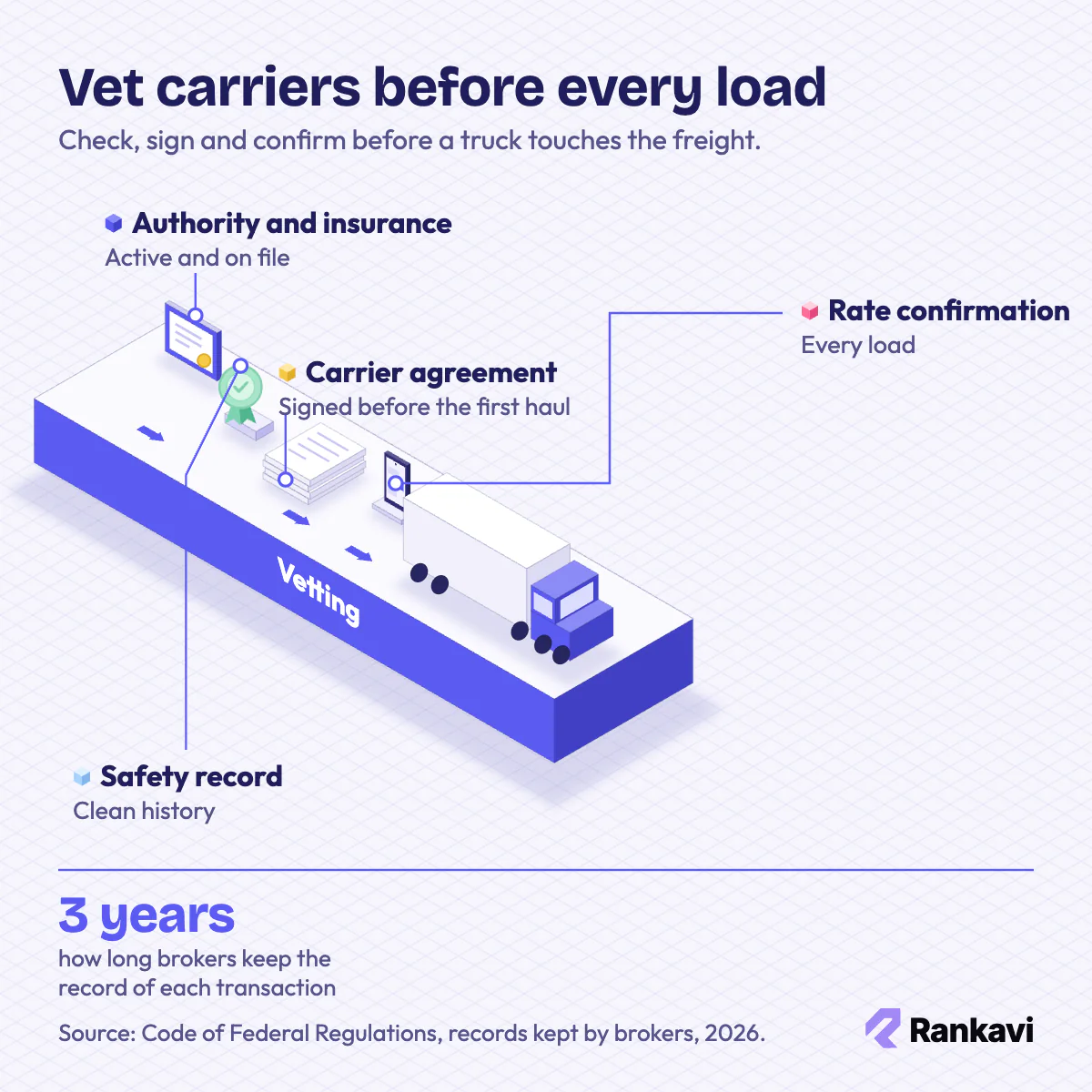
A consistent process beats gut feel. Brokers confirm active operating authority, a valid certificate of insurance and a clean safety history. They also watch for identity theft and double brokering, where a fake carrier re-sells the load.
Carrier identity theft is a growing risk. A thief poses as a real carrier, takes the load and disappears. Brokers guard against it by calling the phone number FMCSA lists for the carrier, not the number in the email. A change in bank details or email domain is a warning sign.
“There is no such thing as too much due diligence when assigning one of your customers loads to a new carrier.”
— A member of the InsideTransport forum
Every carrier signs a broker-carrier agreement before the first haul. Each load then gets a rate confirmation listing pickup, delivery, rate and special terms. A shipper packet does the same job on the customer side.
Federal regulations in force in 2026 require a record of each transaction, kept for three years. The record lists the shipper, the carrier, the bill of lading number and the broker’s compensation. A TMS stores these files automatically.
9. Win the First Shipper Accounts
Shippers are the scarce side of the market, so sales start on day one. Manufacturers, distributors and growers in the chosen niche make the first call list.
Cold calls and emails open the door, but follow-up wins the freight. Many shippers test a new broker with one small load.
Shippers care about reliability more than price. They ask for proof of authority, insurance and references. A broker with a narrow niche can name carriers who already run those lanes. That makes the pitch more credible than a general offer. On-time delivery and clear updates then earn the next lane.
“In the past month, I have probably called over 50-60 shippers. It is EXTREMELY difficult to get these guys on the phone”
— A new broker on the TruckersReport freight broker forum
Industry events and conferences build the network fast. Brokers meet shippers and carriers in person, and those contacts often send referrals.
A simple website and active social profiles make the brokerage look real. Shippers check the business name online before they tender freight. The site should list the authority number, freight modes and contact details.
10. Scale With Freight Agents and Staff
Growth comes from more people selling freight, not more trucks. Many brokerages add freight agents who bring their own shippers and use the broker’s authority, bond and back office.
A back office makes the agent model work. Billing, carrier vetting, customer setup and claims handling move to the brokerage. Agents then spend their day selling and booking loads.
Timing decides whether growth sticks. Scaling too fast strains cash and systems, while scaling too slowly wastes software and staff. A written plan with clear volume targets keeps the pace steady.
Agent contracts need care. The brokerage carries the risk of an agent’s mistakes, so many brokerages review the agent’s customers and carriers first. Commission, desk fees and ownership of customer accounts should be settled in writing before an agent joins.
Certification adds credibility as the team grows. The Certified Transportation Broker designation comes from the Transportation Intermediaries Association. It is earned through a course and an exam on contracts, pricing and regulation.
11. Appear in Shippers’ ChatGPT and AI Broker Picks
Logistics managers now ask ChatGPT, Gemini and Perplexity which freight brokers handle a lane or a freight type. The answers lean on trade publications, broker directories and “top brokerage” lists that already name a firm.
A new brokerage gains an early edge when those third-party sites mention it by name. Rankavi is a software as a service (SaaS) platform that publishes brand mentions in articles on indexed third-party websites. Brokerages use it to earn ChatGPT citations through articles on relevant logistics sites.