

Starting a phone case business means designing or sourcing cases for popular phones and selling them online. The U.S. Census Bureau, which publishes federal retail data, reported that e-commerce made up 17.1% of US retail sales in the second quarter of 2026.
My name is Michal Sieroslawski, and I help phone case brands appear when shoppers search online. Asking an AI assistant is becoming a normal way for shoppers to compare phone case brands. Earning a spot in those suggestions can make a real difference early on.
The order keeps cash safe: cheap decisions on niche, sourcing and price come before any bulk order or paid marketing. Each of the eleven steps below builds on the last, from phone case idea to first paying customer.
- Choose Your Phone Case Niche
- Research Buyers and Phone Models
- Pick a Sourcing Model
- Design Cases and Order Samples
- Price Each Case for Profit
- Fund the First Production Run
- Register the Brand and Protect Designs
- Build the Online Store
- Market Cases on Social Media
- Grow Into New Models and Channels
- Appear in Google AI Overviews for Case Shoppers
1. Choose Your Phone Case Niche
A phone case niche means the style, protection level and buyer a brand commits to. A clear niche keeps a small brand from competing with every cheap case online.
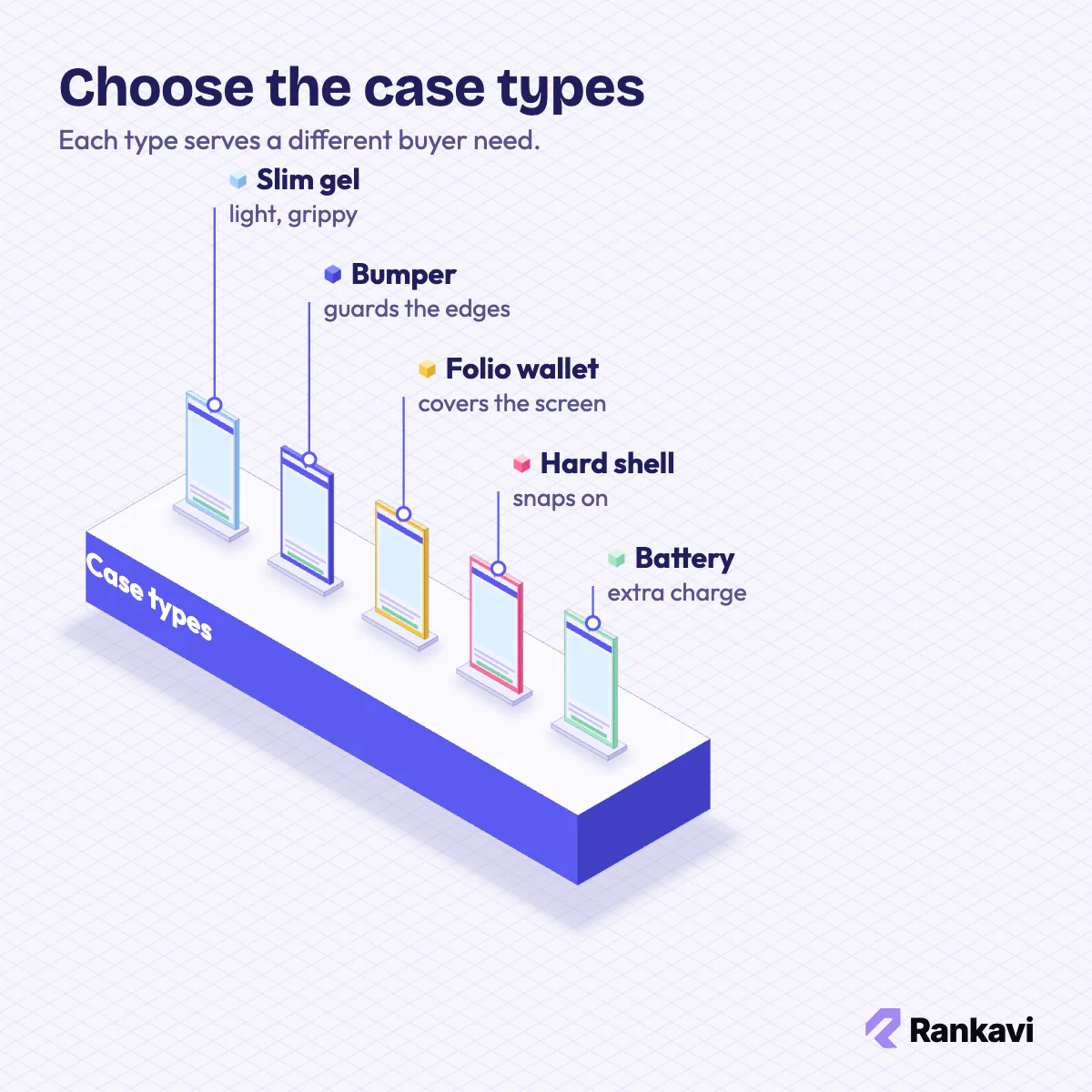
Case types set the product line. Slim gel cases, bumper cases, folio wallets, hard shells and battery cases each serve a different need. Most new brands start with one or two types.
The niche can be a theme or an audience. Eco-friendly buyers, fashion-minded teens, artists and outdoor workers all want different cases. A focused audience also decides materials and suppliers.
A niche combines three choices: a case type, a buyer and a selling angle. A rugged case for outdoor workers and a floral slim case for students are different niches. Both can fit the same phone model.
A unique selling proposition (USP) separates the brand from mall kiosks. Custom names, recycled materials or extra drop protection all work as a USP. Handmade art cases suit founders with craft skills and support premium pricing.
Phone model is part of the niche too. iPhone cases draw the biggest audience and the most competition. Other Android models face less competition, but each needs its own template. Starting with one niche and one or two case types limits risk. New niches can follow once the first one sells.
2. Research Buyers and Phone Models
Market research reveals who buys the cases and which phones they carry. A brand that skips it often prints designs for models few buyers own.
The target buyer gets a written profile. Age, interests, lifestyle and spending habits shape every design choice. Younger buyers chase trends, while older buyers often pay more for durable protection.
Phone models need careful selection, because each model needs its own case. The Pew Research Center is a nonpartisan research organization in Washington, D.C. It found in 2025 that 91% of US adults own a smartphone. Popular iPhone and Samsung Galaxy models cover most of those buyers.
Each new phone launch retires older templates, so a brand needs a plan for which models to keep. Demand also shifts toward the newest models, and older models sell slowly.
Competitor stores reveal the gaps. Many shops sell either very cheap cases or bulky protective ones. Stylish cases with solid protection often sit between those two groups. Google Trends, a free Google tool that charts search interest over time, shows which styles are rising before production.
Marketplace listings add proof of demand. Many reviews on competing cases show that buyers want the style. Repeated complaints in those reviews point to a gap a new brand can fill. Narrowing a crowded niche by buyer or style makes it easier to win.
3. Pick a Sourcing Model
A sourcing model decides who makes the cases, who holds stock and how much each sale earns. Phone case brands choose between print on demand, bulk manufacturing and dropshipping.
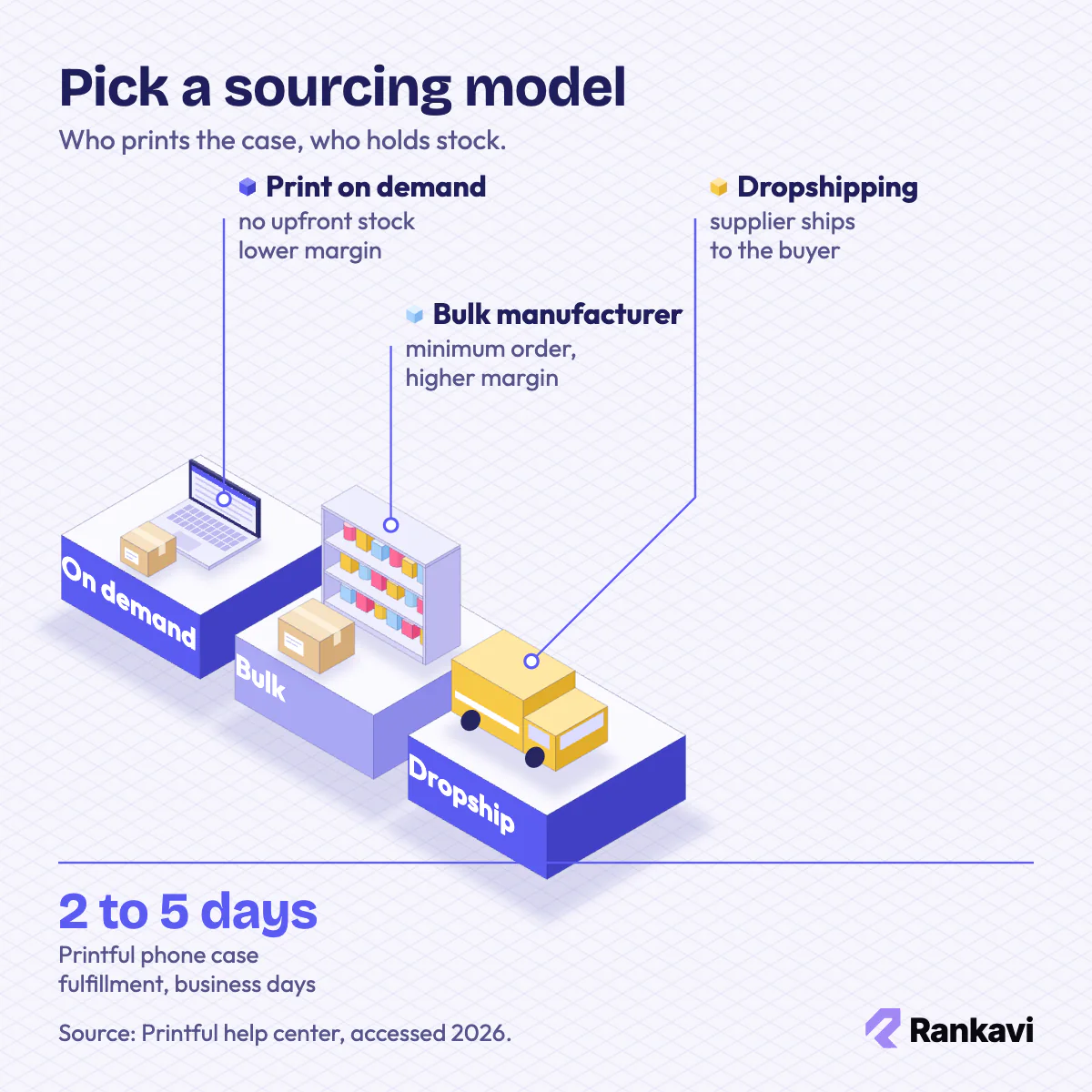
Main sourcing models for phone cases:
| Model | Upfront stock | Margin per case |
|---|---|---|
| Print on demand | None | Lower |
| Bulk manufacturer | Large order | Higher |
| Dropshipping | None | Lower, little design control |
Print on demand suits a first launch. Printful is a print-on-demand company that prints and ships each case under the seller’s brand. Its help center lists phone case fulfillment at 2 to 5 business days. The trade-off is a narrower case range and slimmer margins.
Bulk manufacturers lower the cost per case. They set a minimum order quantity (MOQ), so the brand buys and stores many cases at once. Setup, tooling, shipping and inspection fees belong in every quote.
Alibaba is a Chinese business-to-business marketplace that lists case factories with bulk minimums. Dropshipping suppliers on AliExpress ship ready-made cases straight to buyers. Supplier vetting matters in every model. Good suppliers specialise in cases, show real reviews and send samples before any large order.
Print on demand trades control for low risk. Bulk manufacturing gives more control over materials and print quality, but the brand carries the stock risk. Dropshipping gives the least control over quality and delivery, so reviews and test orders matter most there.
4. Design Cases and Order Samples
Case design starts with the material and the supplier’s template. The template shows where the camera cutout and edges fall on each model.
Common case materials:
| Material | Main quality |
|---|---|
| Polycarbonate (PC) | Hard and durable |
| Thermoplastic polyurethane (TPU) | Flexible and shock absorbing |
| Silicone | Soft grip and light weight |
| Leather | Premium look for wallets |
Design software turns ideas into print files. Adobe Photoshop, Canva and the editors inside print-on-demand apps all export case artwork. Mockup generators preview the design on several phone models.
Freelance designers fill skill gaps. Dribbble shows designer portfolios, while Fiverr offers lower-cost freelance work. Clear briefs keep every design inside the brand’s style.
Samples protect the launch. A physical case shows fit, print sharpness and colour accuracy. Samples also supply the first product photos and videos. Personal options, such as names or photo uploads, need their own sample test.
Fit is the main reason buyers return a case. Buttons, ports and camera cutouts must line up on every model, so each model gets its own sample. Print on demand and bulk samples can differ, because a factory run uses different equipment than a print-on-demand shop.
5. Price Each Case for Profit
Case pricing sets how much of each sale is left after production, fees and shipping. A phone case sells at a small ticket, so every cost line matters.
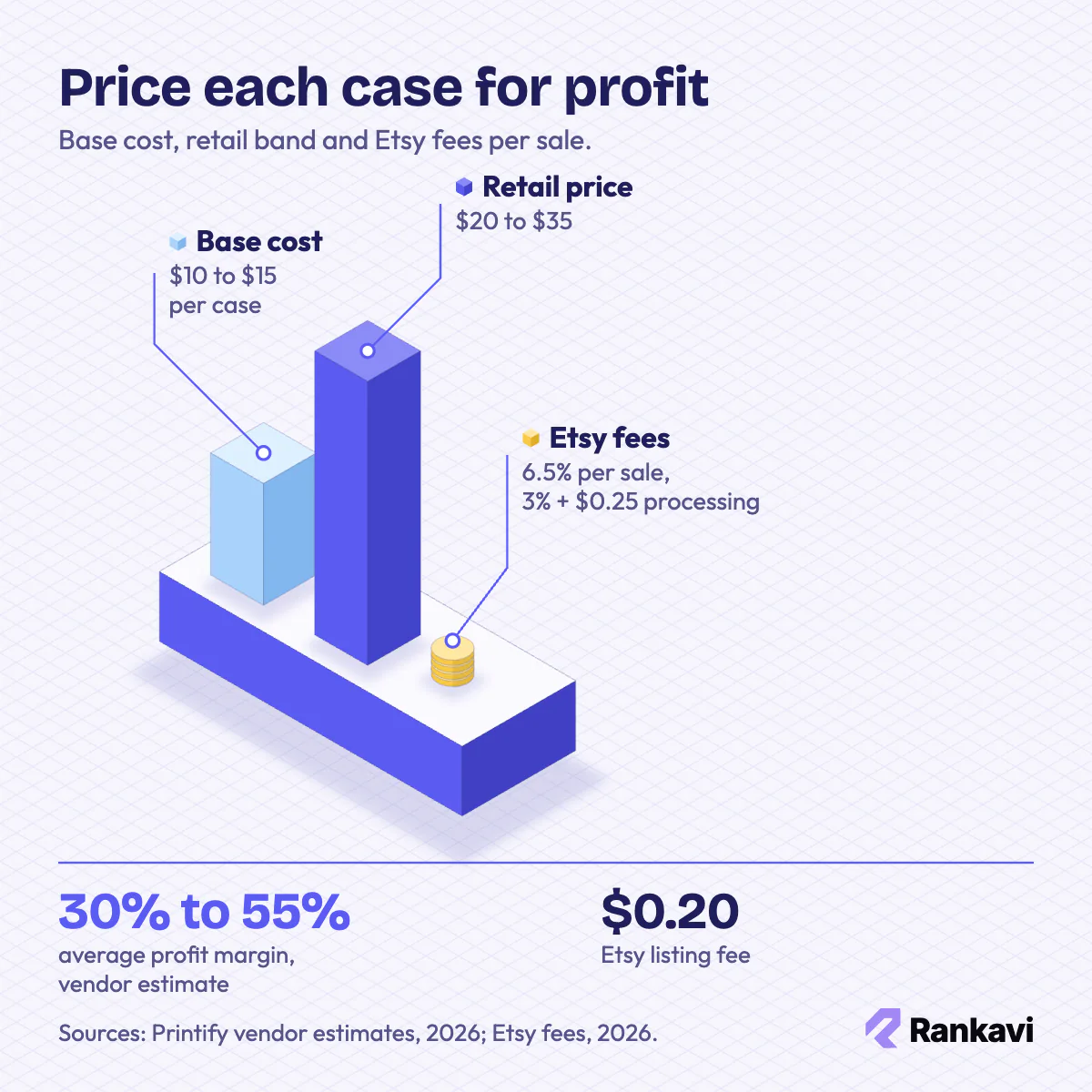
Pricing starts with the unit cost. Production, packaging, shipping and a fair value for design time add up per case. Fixed costs, such as store software, get spread across expected monthly sales.
A profit margin goes on top. Printify is a print-on-demand platform that connects sellers with print providers. It estimated in 2026 that phone cases cost $10 to $15 to make and retail for $20 to $35. That retail band is the benchmark most case sellers check first, because it decides break-even. Premium designs and handmade cases carry higher prices than basic gel cases.
Platform and card fees come out of every sale. Etsy is an online marketplace for handmade and custom goods. As of 2026, it charges $0.20 per listing and a 6.5% transaction fee. Its US payment processing adds 3% + $0.25 per sale in 2026. Those fees belong in the price before launch.
Bundles raise the order value. Grip rings, chain straps and screen protectors pair well with a case. A small bundle discount often lifts the average order more than a sitewide sale.
Cheap cases and heavy discounts shrink margins fast, because shipping and fees stay the same on a small order. Setting a price floor before any sale keeps discounts from turning an order into a loss.
Startup money at a glance:
| Item | Typical figure |
|---|---|
| Startup cost | Little to no stock cost with print on demand; a bulk model adds the opening order (no sourced dollar range found) |
| Main costs | Case base cost $10 to $15; Etsy fees of $0.20 per listing, 6.5% per sale and 3% + $0.25 processing; trademark filing $350 per class |
| Typical margin | 30% to 55% average profit margin on print-on-demand cases (vendor estimate) |
| Time to open | Set by sample orders and store setup; print-on-demand cases ship within 2 to 5 business days |
Sources: Printify and Printful vendor estimates and help pages (2026); Etsy fee page (2026); Fish & Richardson, an intellectual property law firm (2025).
6. Fund the First Production Run
Startup funding covers samples, the store, branding and any bulk order before sales arrive. Print-on-demand brands need far less cash than brands that buy stock.
Startup costs fall into a few groups. Business registration, the website plan, samples, design work and launch marketing come first. A bulk model adds the opening order and storage.
Personal savings fund most small case brands. Print on demand lets a founder pay for each case only after a customer pays. Profits from early sales can then fund the first bulk order.
Bulk ordering also brings storage, shipping and inspection costs, and unsold designs stay as stock. Ordering a small batch of the best seller first limits that risk.
A bulk order ties up cash for weeks. Payment, production and shipping all happen before the first case sells. Small business loans and online lenders help once sales prove demand.
Pre-orders and crowdfunding are another route, because buyers pay before production. Each route has a trade-off: loans add repayments, and pre-orders add a delivery deadline the brand must meet.
7. Register the Brand and Protect Designs
Registering a phone case brand creates the legal business that collects payments and owns its designs. Online case sellers handle this once funding is ready.
The name needs checks first. Social handles, the domain and the state business database should all be free. The Secretary of State’s office usually runs that database.
Most solo founders choose a sole proprietorship or a limited liability company (LLC). An LLC adds paperwork but protects personal assets. Case brands get a free employer identification number (EIN) from the Internal Revenue Service (IRS), which runs federal tax collection.
Design rights need care. Team logos, cartoon characters and brand names belong to their owners. Original art, licensed images and a registered trademark keep the brand safe from takedowns. The United States Patent and Trademark Office (USPTO) issues trademark registrations and has charged $350 per class since January 2025.
Trademark registration protects the brand name, not the artwork. Copyright protects original art from the moment the work is created. Licensed or fan-made designs need permission, because marketplaces remove listings that copy protected characters or logos.
8. Build the Online Store
An online store gives the brand a home where buyers check its cases and its credibility. Buyers often visit the brand’s own site before ordering from a marketplace.
Shopify, a Canadian commerce platform, is the common choice for case brands. Ready themes, print-on-demand apps and marketplace connections all run from one admin. Etsy and Amazon add extra reach.
A brand’s own store keeps control of customer data and pricing. Marketplaces bring ready traffic at the cost of fees and rules. Many small brands use both.
Product pages do the selling. Clear photos, the phone model list, materials and protection details answer most questions. About, contact, shipping and return pages build trust.
Inventory needs a plan even for small cases. Options include a shelf at home, a rented warehouse or a supplier that holds stock. Tracking by model and design shows when to reorder.
Shipping completes the order. Tracking numbers and order notifications keep buyers calm. Fast, reliable delivery earns repeat buyers.
Returns and exchanges need a clear policy, because a wrong-model order is common with phone cases. A fit guide on each product page reduces those returns.
9. Market Cases on Social Media
Phone cases sell through visuals, so social media carries most early marketing. Short videos show the case on a real phone in real use.
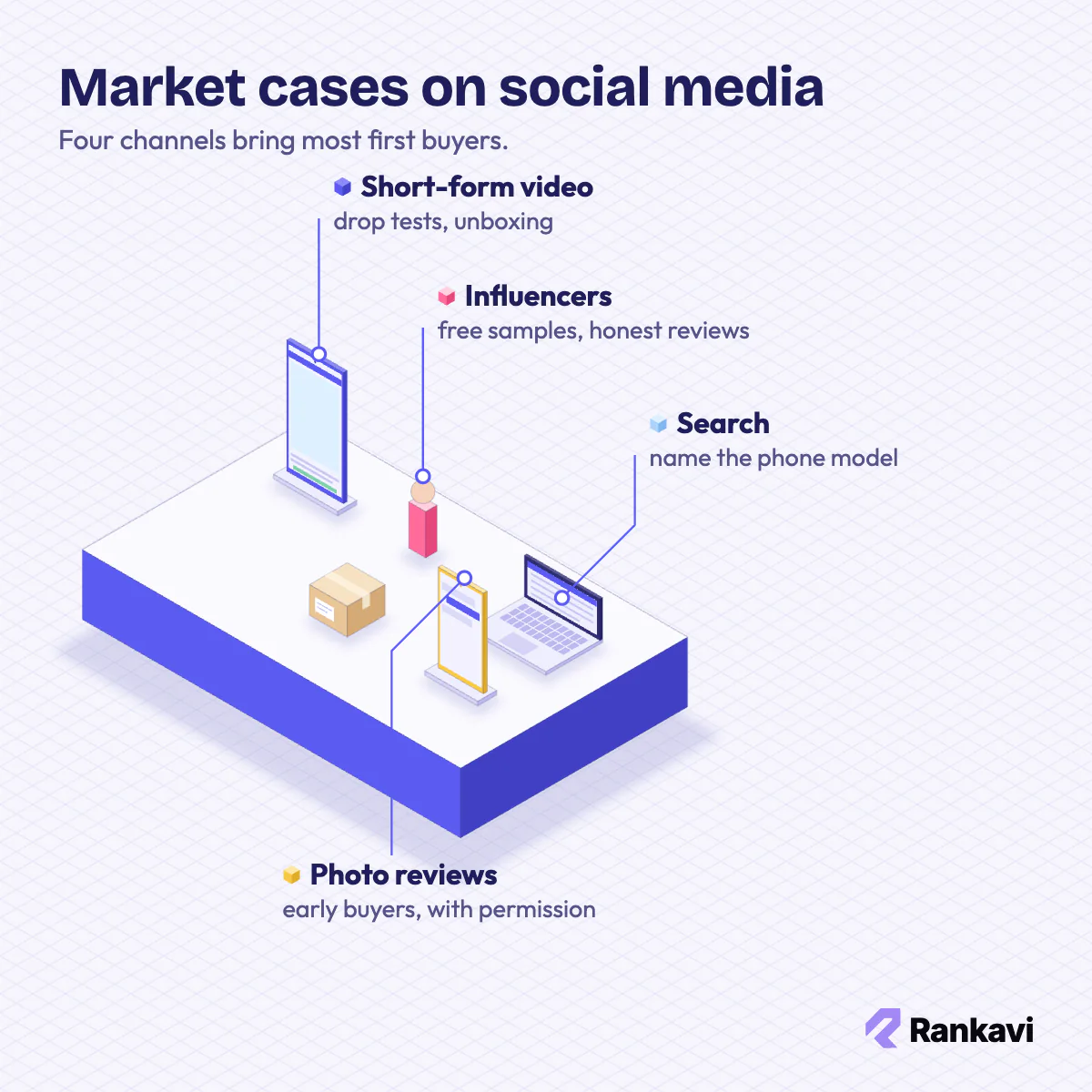
Four channels bring most first buyers:
- Short-form video: drop tests, unboxing and outfit-matching clips on TikTok and Instagram
- Influencers: free samples for honest reviews from creators with a matching audience
- Search: product titles that name the phone model and the case style
- Reviews: photo reviews from early buyers used as testimonials with permission
Model-specific keywords catch ready buyers. Shoppers search for the exact phone, the case type and the style. Product titles and blog posts should use those words.
Word of mouth grows from happy buyers. Requests for reviews after delivery add social proof. A small loyalty discount turns a first buyer into a repeat one.
Short videos work best when they show the case in use, such as a drop test or an unboxing. Influencer partnerships work when the creator’s audience matches the niche. A free sample gives the creator something to review honestly.
10. Grow Into New Models and Channels
Growth follows sales data and new phone launches. Every new flagship phone creates fresh demand for cases.
Sales data shows the next move. Best-selling designs get more models, and weak designs leave the store. Customer reviews point to missing features or styles.
New channels widen the reach. Amazon, TikTok Shop and local gift shops each add buyers the main store misses. Wholesale orders from retailers suit brands with steady bulk supply.
Each new channel adds fees, rules and customer service work. Adding one channel at a time makes it clear which one pays off.
Help arrives when orders outgrow one person. Packing, customer service and content creation are common first roles. Clear routines keep quality steady as volume grows.
11. Appear in Google AI Overviews for Case Shoppers
Case shoppers now ask AI assistants for the best case for a new phone. Google AI Overviews, ChatGPT and Perplexity answer with brand names.
Those answers draw on trusted third-party pages. Review sites, gift guides and “best cases for” roundups supply the names. A new case brand gains from appearing on those pages early.
Rankavi is a software as a service (SaaS) platform that publishes brand mentions in articles on indexed third-party websites. Case brands that want to get mentioned in AI Overviews can start with a few articles about their designs.