

Starting a restaurant business means turning a food concept into a licensed, funded and staffed dining room. The National Restaurant Association is the largest U.S. restaurant trade group. It projected $1.55 trillion in U.S. restaurant and foodservice sales for 2026.
A bit about me: my name is Michal Sieroslawski, and I help restaurants become easier to find online. ChatGPT and Google’s AI Overviews now suggest restaurants by name, and that list matters.
Each step below fixes a cost or a rule for the next one. The menu decides the kitchen. Money is lined up before a lease, and the health permit needs a real address. The twelve steps below show how to start a restaurant business, in order.
- Choose Your Restaurant Concept
- Build a Menu That Earns Margin
- Write a Restaurant Business Plan
- Register Your Restaurant Company
- Fund the Opening and First Months
- Find a Location That Fits
- Get Food Safety Permits and Licenses
- Buy Kitchen Equipment and Furniture
- Set Up Your POS and Back Office
- Hire and Train Your Opening Team
- Market the Soft and Grand Opening
- Appear When Diners Ask AI
1. Choose Your Restaurant Concept
A restaurant concept means the central idea that defines the food, service and feel of the place. Every later decision, from the lease to the logo, follows it.
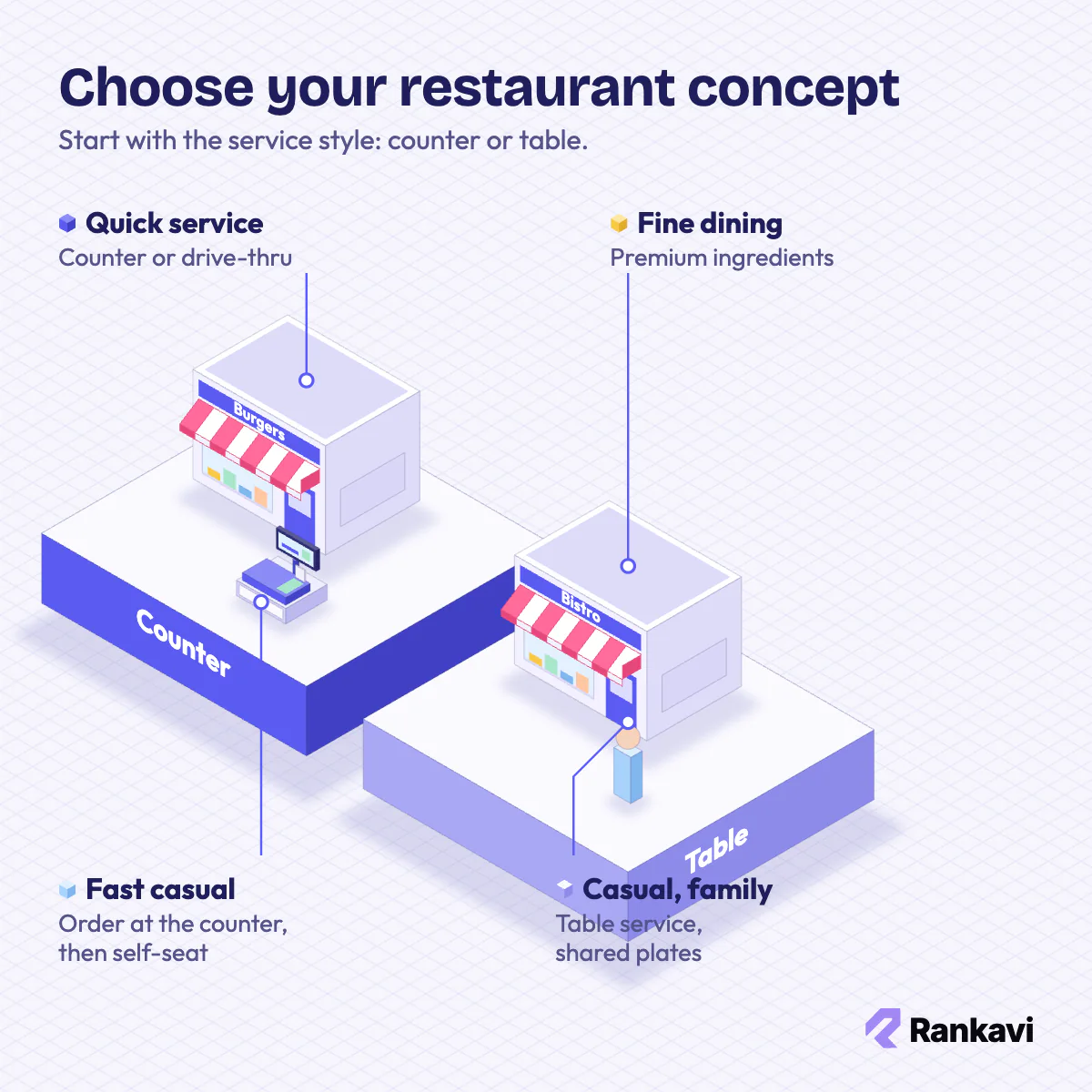
Service style comes first, because it sets the startup budget. A quick service restaurant sells a short menu at a counter. Fast casual adds better ingredients and customization without table service. Casual, family and fine dining add servers and a longer meal.
Common service styles:
| Service style | How guests order | Typical feel |
|---|---|---|
| Quick service | Counter or drive-thru | Fast, simple menu |
| Fast casual | Counter or kiosk, then self-seating | Fresher, customizable dishes |
| Casual dining | Table service | Relaxed, affordable entrees |
| Family style | Table service, shared platters | Group meals |
| Fine dining | Full table service | Premium ingredients, attentive service |
On a crowded street, a concept needs a distinct angle. Owners look for a gap, such as a busy shopping area with nowhere for brunch. Fads fade, so lasting demand beats this year’s trend.
A concept has more parts than service style. Cuisine, price point, target guest, mealtime and atmosphere all need an answer. A narrow cuisine is easier to cook consistently and to market than a menu meant for everyone.
Owner fit matters as much as market fit. A fine dining room depends on one skilled chef and a large team. A counter-service format depends on systems, which suits an owner who wants a simpler operation.
A franchise is the alternative to inventing a concept. It trades creative control for a proven system and training, usually in exchange for fees and set rules.
Cheaper formats can test an idea first. A ghost kitchen cooks in rented space and sells only through apps such as Uber Eats or Grubhub. Food trucks and pop-ups also prove a menu before anyone signs a ten-year lease.
Ghost kitchens carry a trade-off. Delivery apps charge a commission on each order, and with no storefront the brand attracts no walk-in guests. The format tests a menu but builds little local following.
Before committing, owners ask people on the target street what kind of restaurant is missing. A small tasting group from the target audience adds detail, and honest answers cost far less than a failed opening.
Competitor reviews show unmet needs. Repeated complaints about slow service or a lack of vegetarian dishes point to a gap. A tasting event, pop-up or market stall then shows whether strangers will pay the menu price. Repeat buyers are the strongest sign.
Common concept mistakes include a menu that tries to be everything, copying a fad and ignoring who lives nearby. A concept that needs more staff than the budget allows fails too. The concept should fit in one sentence before the next step starts.
2. Build a Menu That Earns Margin
A menu turns the concept into dishes, prices and a kitchen workload. It decides the equipment, the cooks and the guests, which is why it comes before the plan and the kitchen.
Pricing starts with food cost: the owner costs every ingredient, then sets a price that keeps the plate in line. Square, a point-of-sale vendor, puts food and beverage at 28% to 35% of revenue and labor at 25% to 35% in its 2026 cost guide. Together those two lines, called prime cost, eat most of every sales dollar.
Key decision benchmark: food cost percentage, the ingredient cost of a dish divided by its menu price. Every point above target comes out of profit. For full-service restaurants, median pretax income was 2.8% of sales in 2024, per a 2025 National Restaurant Association abstract.
A short menu works better at launch. Fewer items mean less waste, faster training and steadier plates. The list can grow once the line runs smoothly.
Menu engineering then sorts every dish by margin and popularity. High-margin favorites get the best spots on the printed menu; low-margin, low-demand dishes quietly leave. Staff tastings before opening show which recipes need another pass.
Each dish gets a recipe card listing every ingredient, its quantity and its cost. When a supplier raises a price, the card shows the effect on that dish’s margin right away.
Local prices set a ceiling. A price built only from cost can sit above what nearby restaurants charge. Owners compare the draft menu with local menus before printing it.
Allergens and dietary needs belong on the menu from the start. Clear labels and a few vegetarian or gluten-free dishes widen the audience and reduce risk.
3. Write a Restaurant Business Plan
A restaurant business plan sets out the concept, market, operations and finances in one document. Lenders and investors read it to judge whether the dining room can pay its rent.
Core business plan sections:
- Executive summary
- Company overview and ownership
- Concept and sample menu
- Market and competitor analysis
- Marketing plan
- Operations plan
- Management team
- Financial projections
Its key assumption is covers: how many guests a day, at what average check. Square’s 2026 vendor guide suggests keeping rent at 6% to 10% of projected revenue.
Financial projections carry the most weight with a bank. They include a profit and loss forecast, monthly cash flow for year one and a break-even analysis. An accountant who already works with restaurants helps the numbers hold up.
A break-even analysis shows how many guests a day cover fixed costs such as rent and salaried staff. That number tells the owner how much traffic the dining room needs before it earns anything.
Slower assumptions for the first months look more credible than optimistic ones. Lenders can compare projected covers with nearby restaurants, and a cautious forecast leaves room for surprises.
The executive summary opens the plan but gets written last, once every figure is settled. The U.S. Small Business Administration (SBA) publishes a free plan template that matches what lenders expect.
4. Register Your Restaurant Company
Registering a restaurant creates the legal entity that signs the lease, hires staff and pays taxes. Most independent owners form a limited liability company (LLC), since it keeps personal savings apart from restaurant debts.
Partnerships are common in this trade: one partner runs the kitchen and the other runs the numbers. When investors join, the operating agreement spells out who gets repaid first. Many owners settle it with an attorney.
Next comes an employer identification number (EIN) from the Internal Revenue Service (IRS), which issues it free online. A restaurant needs one before paying cooks and servers.
The name deserves a check too. Owners confirm no nearby restaurant uses it and register it with the state. A trademark helps before a second location.
A separate business bank account keeps restaurant money apart from personal money. It also makes bookkeeping and tax filing simpler. State sales tax registration and payroll accounts follow once the entity exists.
5. Fund the Opening and First Months
Funding determines whether the restaurant can open and survive the slow early months. The budget covers the buildout, the kitchen and the cash that keeps the doors open before profit arrives.
Startup money at a glance:
| Item | Typical figure |
|---|---|
| Startup cost | $175,000 to $750,000 (quick service from $150,000; full service $300,000 to $750,000+) |
| Main costs | Buildout ($100 to $800 per square foot), commercial kitchen ($50,000 to $150,000), furniture and decor ($10,000 to $50,000+), lease deposits, opening inventory and pre-opening payroll |
| Typical margin | Median pretax income of 2.8% of sales for full service and 4.0% for limited service (2024 data) |
| Time to open | 6 to 12 months from concept to opening day; 3 to 4 months in a move-in-ready space |
Sources: Square, 2026; National Restaurant Association, 2025; UpMenu, 2026. Square and UpMenu are restaurant software vendors, so their cost and timeline ranges are vendor estimates.
Worked example: An illustrative 60-seat casual restaurant sells $100,000 a month. Food at 32% costs $32,000, labor at 32% another $32,000, rent at 8% $8,000. That leaves $28,000 for utilities, insurance, repairs, marketing and loans. A $6 plate priced at $18 runs 33%. At 36% food cost, $4,000 a month vanishes, more than a 2.8% margin’s $2,800. All before owner pay, interest and taxes.
Funding options include SBA-backed bank loans, credit union loans, equipment financing, private investors and crowdfunding. Most openings stack sources. An SBA 7(a) or bank loan usually covers the buildout, and investors or family fill the gap. Approval should arrive before the lease is signed.
Lenders may ask owners to back a loan personally, so a failed restaurant can put personal assets at risk. Owners read the loan terms before signing.
Equipment financing spreads the kitchen cost over time, which keeps cash for the buildout and the reserve. The trade-off is interest and a longer commitment. Investors give cash in exchange for ownership or repayment terms, so the operating agreement states those terms before money moves.
Working capital is the most underestimated line. Square’s 2026 guide notes that many restaurants take one to three years to reach consistent profitability, yet rent and payroll start before opening night. A reserve covers permit delays and slow first winters.
6. Find a Location That Fits
A location shapes who walks in, what the rent costs and how hard marketing has to work. Concept, menu and staff can change later; the address is far harder to undo.
Site checks cover foot traffic, visibility, parking and transit, plus nearby competitors and delivery access. Zoning decides whether a restaurant may operate there at all, so owners ask the city before falling for a space.
Visibility needs differ by format. A counter-service concept depends on foot traffic and parking. A destination dining room can sit on a quieter street if guests plan the trip. Visiting at lunch, dinner and weekends shows the real traffic.
Most first-time owners lease rather than buy, which keeps cash free for the kitchen. Landlords sometimes offer a tenant improvement allowance toward the buildout. Triple-net leases add taxes, insurance and maintenance on top of base rent. That full occupancy cost belongs in the plan.
A lease deserves a lawyer’s review. Terms on rent increases, renewal options and who pays for repairs shape costs for years. A contingency clause lets the owner exit if permits or financing fail.
A second-generation space saves money. A former restaurant often keeps its hood, grease trap and kitchen layout. Converting a shop usually needs change-of-use approval and heavier work.
Inside, the layout splits into front of house and back of house. Servers need clear paths through the dining room. The kitchen flows from storage to prep, cooking and plating.
7. Get Food Safety Permits and Licenses
Restaurant permits cover the business, health, building and alcohol approvals a kitchen needs before serving the public. With an address and floor plan in hand, the local health department and city hall set the exact list.
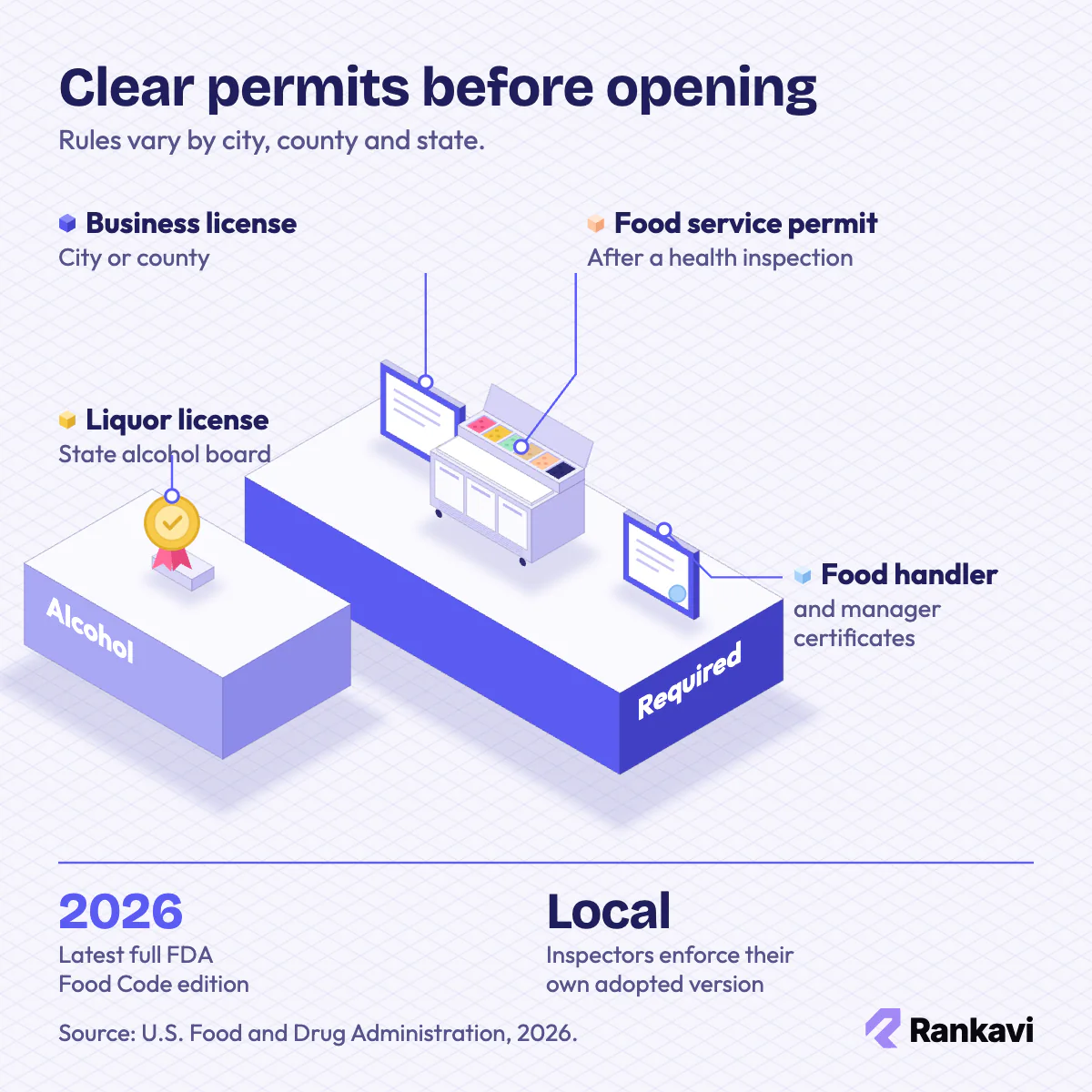
Common restaurant licenses and permits:
| License or permit | Issued by | Purpose |
|---|---|---|
| Business license | City or county | Permission to operate locally |
| Food service permit | Local health department | Issued after a health inspection |
| Food handler and manager certificates | Health department or approved course | Proof of food safety training |
| Certificate of occupancy | Building department | Space meets building and fire codes |
| Sign permit | City planning or building office | Exterior signage |
| Sales tax permit | State revenue department | Collecting tax on meals |
| Liquor license | State alcohol board | Serving beer, wine or spirits |
Inspection drives the food service permit. Applications usually ask for a menu, a floor plan and proof of food handler training. Plan review happens before the buildout starts. The final health inspection follows equipment installation, and the permit is issued after it passes. Inspectors return after opening, often unannounced.
Fees and timelines differ by city and state, so the health department and city hall are the first calls. A tracker listing each agency, deadline and renewal date prevents a missed step.
Those inspectors work from a model rulebook published by the U.S. Food and Drug Administration (FDA): the FDA Food Code. Its latest full edition is dated 2026. States, counties and tribes adopt it, often with changes, so each kitchen answers to its local version.
A liquor license follows state rules and background checks on the owners. Some states cap the number of licenses, so the application can take months and often sets the opening date.
Insurance sits on the same checklist. Landlords usually require general liability before move-in. Liquor liability covers alcohol service, and workers’ compensation starts with payroll.
8. Buy Kitchen Equipment and Furniture
Equipping a restaurant involves buying the cooking, cold storage and dining gear the menu actually needs. With the menu set, the list writes itself: a burger concept needs a griddle, a pizza concept a deck oven.
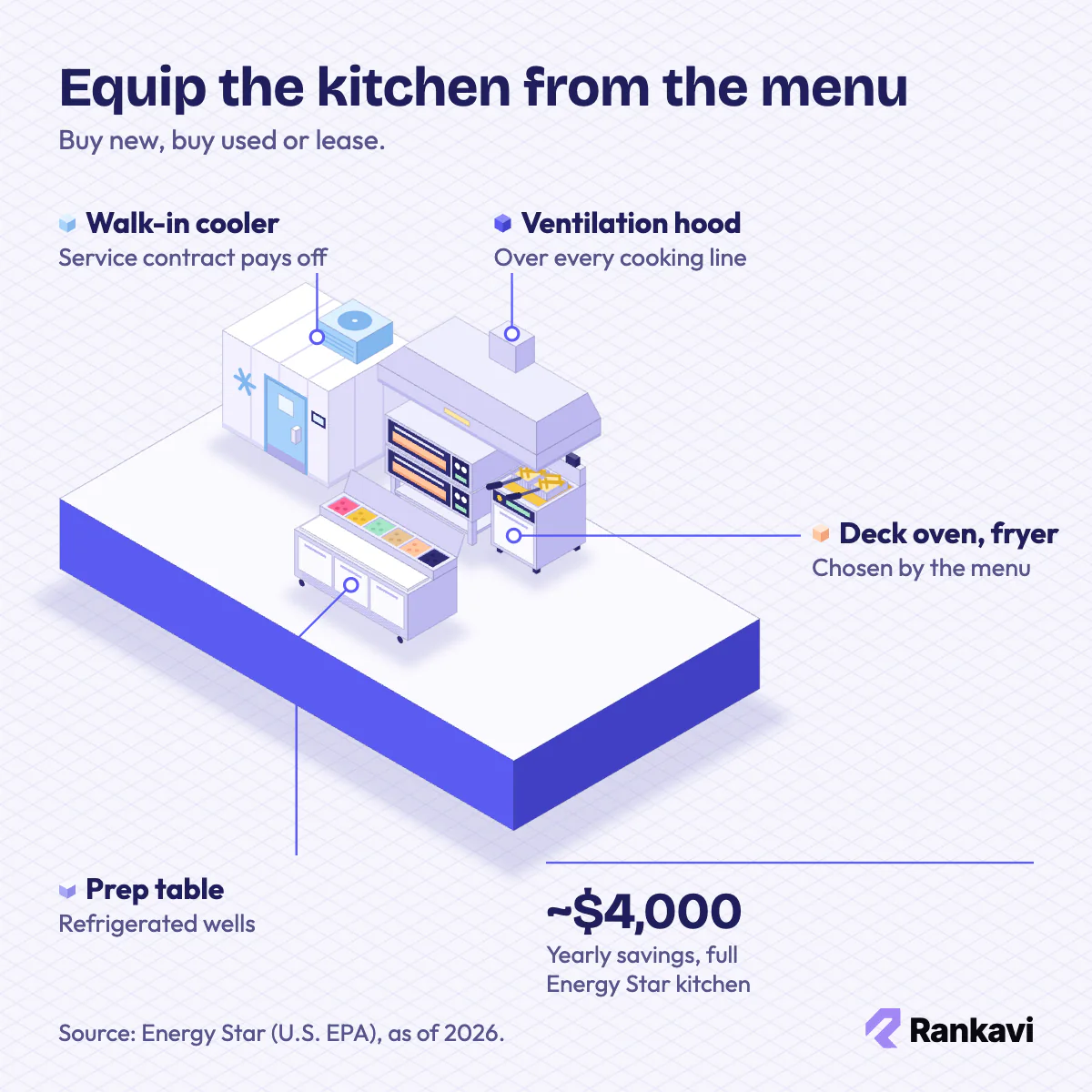
A restaurant kitchen usually needs six equipment groups:
- Ranges and ovens
- Grills and fryers
- Reach-in and walk-in refrigeration
- Prep tables and shelving
- Commercial dishwasher
- Ventilation hood
New, used or leased: each has a place. New gear carries warranties, and used shelving from auctions saves cash. Leasing suits pricey specialty items while demand is unproven.
Layout and utilities limit the choices. A hood needs ventilation approval, a fryer needs gas or power and a dishwasher needs drains. The landlord and the plan reviewer confirm what the space supports before orders are placed.
Equipment size should match menu volume. An oversized walk-in wastes space and power, while an undersized fryer slows the line at peak hours. Used units need a working test and service records before purchase.
Energy use matters in a kitchen that runs all day. Energy Star is the efficiency label run by the U.S. Environmental Protection Agency (EPA). As of 2026, it estimates a certified kitchen suite saves about $4,000 a year. Service contracts pay off for dishwashers and walk-ins, since a dead Friday-night cooler costs more.
The dining room needs its own budget. Chairs, booths and bar stools must survive commercial cleaning. Plates, glassware, cutlery and linens complete the room.
9. Set Up Your POS and Back Office
A point of sale (POS) system gives the restaurant one place for orders, payments, tips and sales data. Kitchen tickets, card payments and reports all flow through it.
Counter service needs fast checkout and kitchen tickets, whereas a full-service room needs table maps, split checks and tip handling. Card processing fees deserve a line-by-line comparison, because they are charged on every sale.
A POS should match the menu and service style. Menu modifiers, kitchen screens, ordering links and tip settings differ by vendor. Owners test a demo with real orders. Staff practice on it before opening, since register mistakes cause wrong tickets and wrong charges.
Reservations come next. OpenTable is an online reservation platform, and Resy works the same way; both fill slow nights. Online ordering, scheduling, inventory and accounting software such as QuickBooks complete the back office.
Every week, the owner reviews covers, average check, food cost and labor cost against the plan. Problems caught weekly stay small.
POS data also feeds back into the menu. Best sellers and slow dishes show which items to promote and which to cut. This connects back to menu engineering in step 2.
10. Hire and Train Your Opening Team
Staffing decides how the restaurant feels to guests from the first night. The team splits into front of house, back of house and management.
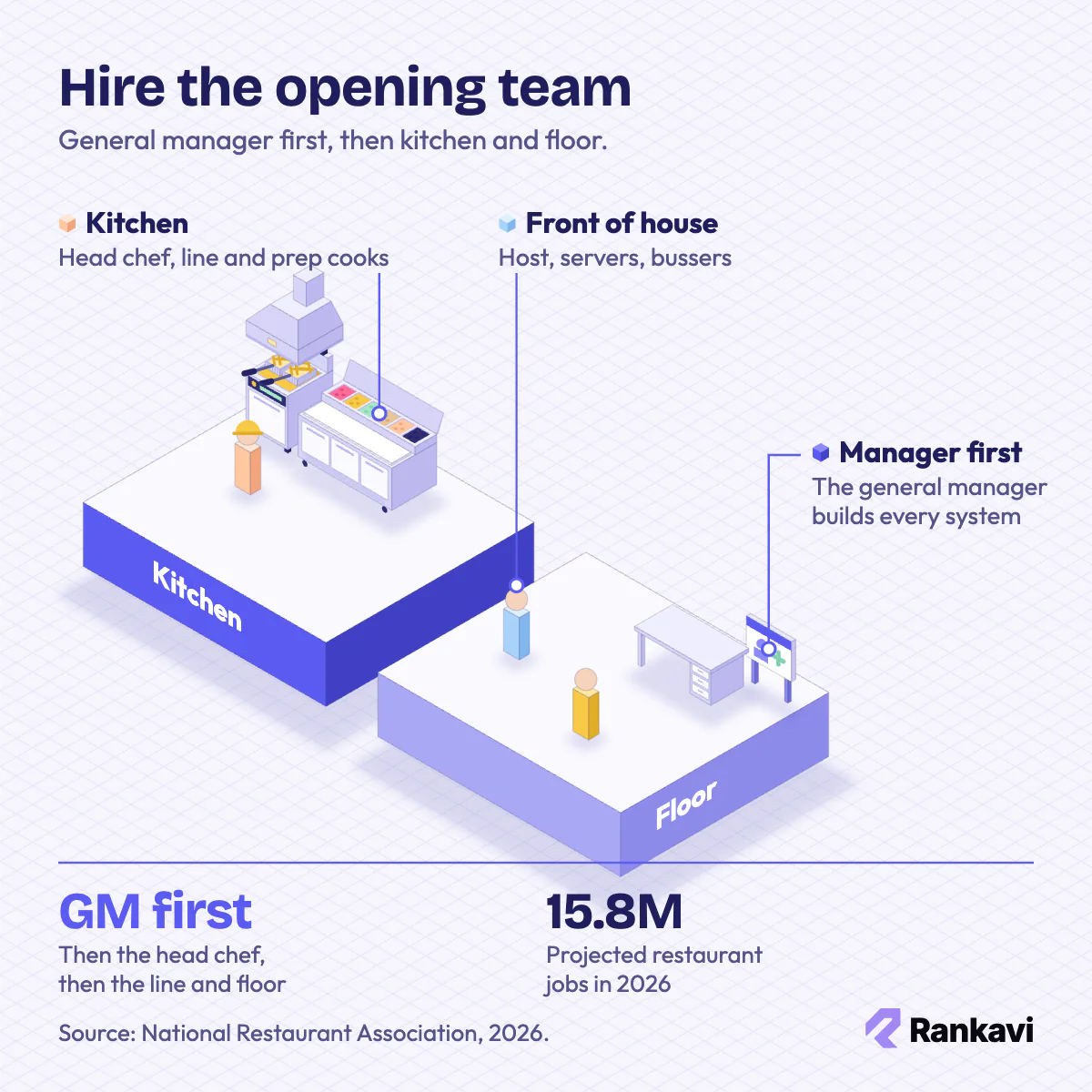
Key restaurant roles:
| Area | Roles |
|---|---|
| Management | General manager, kitchen manager |
| Kitchen | Head chef, sous chef, line cooks, prep cooks, dishwashers |
| Front of house | Host, servers, bussers, food runners |
| Bar | Bartenders, barbacks |
Hiring is competitive. In its 2026 State of the Restaurant Industry report, the National Restaurant Association projected 15.8 million restaurant and foodservice jobs for 2026.
The general manager is the first hire, since a good manager builds every other system, from schedules to service standards. A head chef follows and owns menu execution and food cost.
Pay sets the budget for that first hire. The U.S. Bureau of Labor Statistics (BLS), which publishes federal wage data, reported a median annual wage of $69,390 for food service managers in May 2025.
Recruiting mixes old and new methods: a help wanted sign draws walk-in cooks and servers, while job boards reach managers. Training starts before the first shift, with a written handbook, menu quizzes for servers and cross-training for call-outs.
Interviews work best with a short skills test. A cook runs a station and a server carries a tray during a trial shift. A posted schedule with overlapping shifts and clear break rules reduces call-outs.
A staff dinner before the soft opening lets servers taste the menu and practice service. Written station guides help when someone is absent.
Restaurant payroll has its own rules. Minimum wage, tipped wages and tip pooling follow federal, state and local law. Payroll software handles the math.
11. Market the Soft and Grand Opening
Opening marketing builds the crowd before the doors open and turns first visits into regulars. The work starts during the buildout.
Name, logo, signage and menu design should tell one story. A simple website lists the address, hours, menu and a reservation or ordering link.
Listings come next. Google Business Profile is Google’s free listing for Search and Maps, with hours, photos, menu and reviews. Yelp and Tripadvisor pages add more reviews, and the name, address and phone number should match everywhere.
A soft opening rehearses service. A limited menu for friends, family and neighbors tests the kitchen, the POS and the staff before full public scrutiny.
For the grand opening, the restaurant announces a date weeks ahead and invites local food writers. A first-visit offer gives people a reason to come, and every review gets a reply, including the critical ones.
Soft opening feedback is written down and acted on. Slow tickets, unclear menu items and long waits are fixed before the grand opening. Sharp photos of the dishes and the room serve the website, listings and social posts.
12. Appear When Diners Ask AI
AI visibility places a restaurant in the answers diners get from AI assistants. Diners now ask assistants for “best brunch near me” or “a quiet Italian place for a date.” Microsoft Copilot is one of them, built into Windows and Edge, alongside ChatGPT.
Their picks draw on what independent sites already say about a place. City dining guides, neighborhood blogs and “where to eat in” lists carry more weight than the restaurant’s own website. A new dining room with no outside coverage is easy for an assistant to skip.
Consistency helps assistants and diners alike. The same name, address, hours and menu should appear on the website, Google Business Profile and review sites.
Coverage builds slowly, and no one can promise a placement. Rankavi is a software as a service (SaaS) platform that publishes brand mentions in articles on indexed third-party websites. Restaurants pay from $12 per mention. Owners who want their dining room named when diners ask Microsoft’s assistant can look at Microsoft Copilot citations.