

Starting an embroidery business means stitching logos and names onto garments for paying clients, usually from home. The Promotional Products Association International (PPAI) is the trade group for branded merchandise. It reported $27.1 billion in US distributor sales for 2025.
I am Michal Sieroslawski, and I help embroidery businesses get recommended in AI search. AI answers are quickly becoming a starting point for customers. So being recommended in those chats matters more every year.
The order protects cash. Niche, prices and funding are settled before the machine purchase, and production skills come before marketing. Starting an embroidery business comes down to the eleven steps listed below.
- Choose Your Embroidery Niche
- Write a Lean Business Plan
- Price Embroidery by Stitches and Time
- Fund the Machine and Supplies Together
- Register and Insure the Business
- Set Up a Home Embroidery Workspace
- Buy a Commercial Embroidery Machine
- Learn Digitizing and Production Basics
- Market to Teams, Schools and Businesses
- Grow With Multi-Head Machines and Staff
- Appear in Google AI Overviews for Custom Apparel
1. Choose Your Embroidery Niche
An embroidery niche decides which garments, clients and order sizes the shop is built around. A machine alone is not an offer, so a clear niche gives the first clients a reason to call.
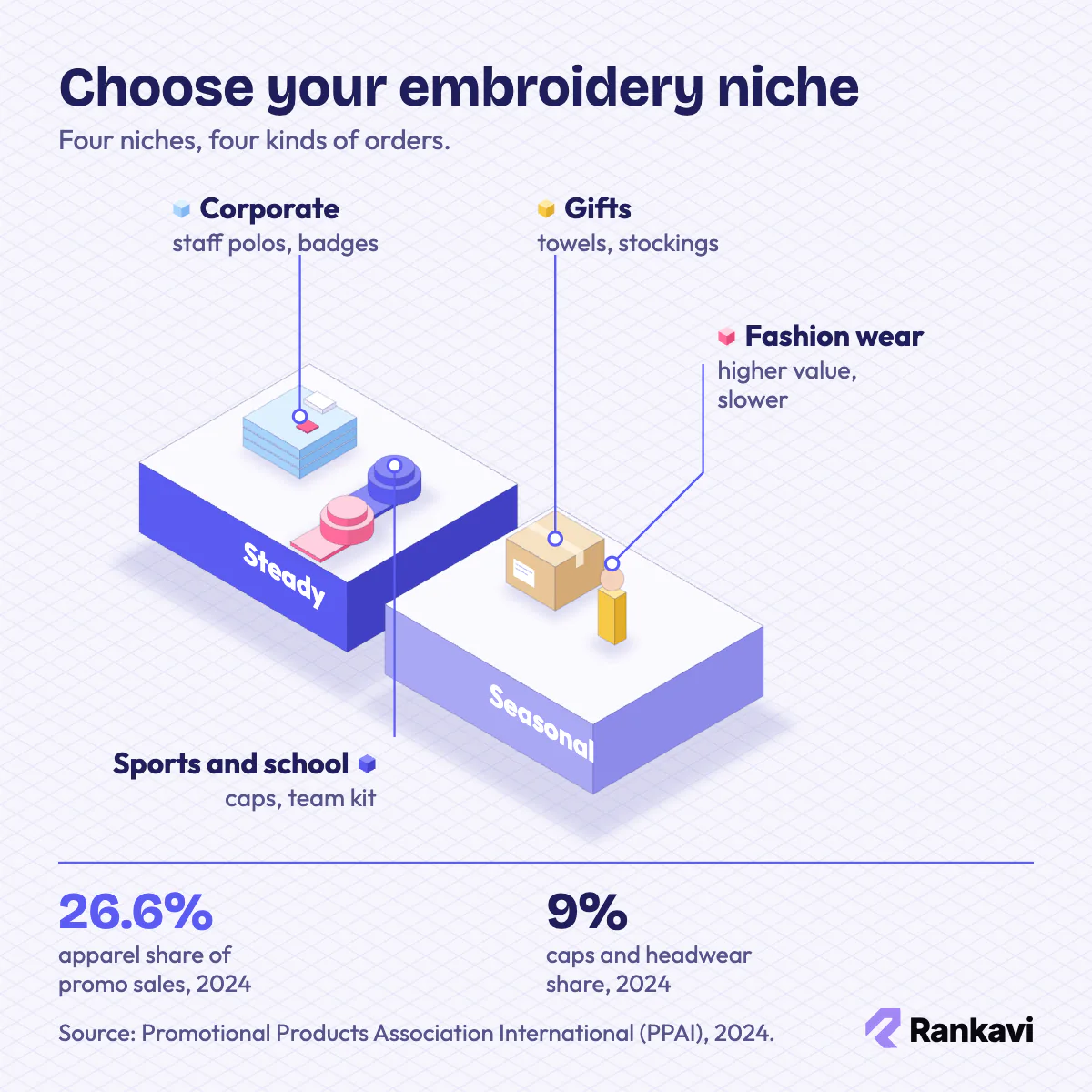
Common embroidery niches pull in different kinds of work:
| Niche | Typical items | Order pattern |
|---|---|---|
| Corporate branding | Staff polos, caps, uniform badges | Steady reorders |
| Sports and school kit | Team jackets, bags, badges | Bursts tied to the calendar |
| Personalized gifts | Towels, stockings, baby items | Seasonal peaks |
| Native and fashion wear | Detailed garment work | Higher value, slower jobs |
The target customer shapes every later choice. Corporate buyers want consistent logos on many pieces. Families buying gifts want names on single items and quick turnaround.
A niche also fits some machines better than others. Caps need a cap frame, while jackets and bags need larger hoops. Checking that the machine can run the work comes before committing to a niche.
Online custom apparel sellers win on catalog size and price. Local shops win on speed, small runs, reruns and stored logo files. A niche where those strengths matter gives a small shop its best chance.
Local competition sets the opening. Flea markets, craft fairs and other home embroiderers show who already serves the area. Schools, churches and youth leagues reveal whether they already have a supplier.
Asking five local buyers who supplies their embroidery now, and what they dislike about it, tests demand faster than guessing. Stitching two or three samples and showing them to prospects is a cheap final check before buying equipment.
Team names, college marks and cartoon characters are trademarked. A shop cannot stitch them for sale without permission from the owner. Niches built on client-owned logos avoid that problem.
Branded apparel is the biggest buyer pool. PPAI reported apparel at 26.6% of promotional products sales in 2024. PPAI also found caps and headwear rose to 9% that year, up from 7.2% in 2023.
Caps deserve a place in most niches. Many shops avoid cap embroidery because of its learning curve. A shop that stitches caps well becomes a one-stop choice for teams and companies.
Starting with one main niche and one backup that shares the same blanks and equipment is safer than splitting attention. Corporate work and team caps pair well, as do gifts and wedding items.
2. Write a Lean Business Plan
A lean plan turns the niche into a written budget, a sales target and a launch order. Lenders and equipment financers usually ask to see one.
An embroidery plan needs five short sections:
- Executive summary: the niche, the services and the owner’s skills
- Market analysis: local buyers, competitors and the gap the shop fills
- Services: garments, decoration methods and order minimums
- Financial projections: expected jobs per week, prices and costs
- Growth plan: when to add a second machine or new services
The key assumption is weekly machine hours. Each projection depends on how many pieces one machine can stitch around hooping and trimming. A conservative figure keeps the plan honest.
Break-even shows whether the shop can pay for itself. It equals monthly fixed costs divided by the average profit left on each order after blanks, thread, stabilizer and labor. Lenders usually check this figure first.
Embroidery demand rises around the school year, sports seasons and the holidays. A plan that assumes flat monthly sales misleads the owner. Conservative, expected and best-case versions of the numbers show a lender that the plan has been tested.
A runway protects the switch to full time. Many owners keep a day job until embroidery income covers their bills. Saving several months of living costs gives the new shop time to grow.
The plan should also name the main risks. Examples are machine downtime, slow early sales, supplier delays and one customer making up most of the revenue. Each risk needs a fallback. Reviewing the plan against real results every quarter keeps it useful.
3. Price Embroidery by Stitches and Time
Embroidery pricing sets the charge for each piece from its stitch count, setup work and machine time. Prices that ignore labor leave the owner working for free.
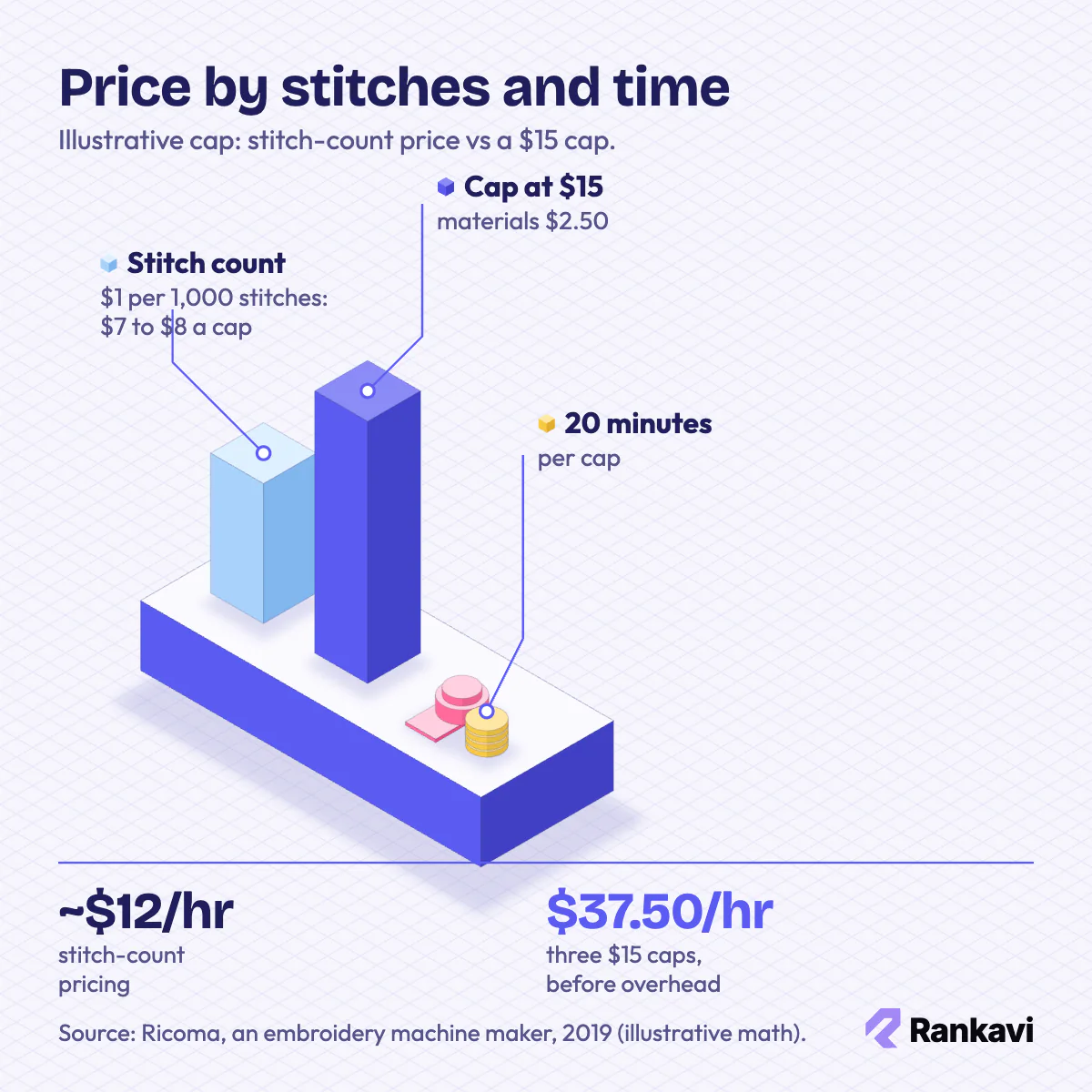
Stitch count is the traditional starting point. Ricoma is a commercial embroidery machine maker. In a 2019 article, it called $1 per 1,000 stitches the common rule of thumb. That older benchmark ignores labor, because hooping and cleanup take as long as the stitching on small cap logos.
Many shops still price by habit. The National Network of Embroidery Professionals (NNEP) is a membership network for shop owners. It surveyed 545 shops for its June 2026 pricing benchmark. In that 2026 report, shops averaged a pricing score of 7.54 out of 20. Many also lacked a defined profit margin target.
A setup fee covers the work before the first stitch. Digitizing, thread changes and test runs happen on every new design. Some shops roll the fee into the garment price, while others list it separately.
The real hourly rate is the honest check. Take the price, subtract thread, stabilizer, outsourced digitizing and power, then divide by the hours spent. Many owners find their first figure lower than expected.
Minimum orders and deposits protect cash. Custom embroidery cannot be resold to another customer. A deposit up front covers the blanks if the client walks away.
Customer-supplied garments change the math. The shop earns no margin on the blank, so the price covers only stitching and setup. A damaged client garment also becomes the shop’s problem, so many shops add a written waiver.
Worked example: An illustrative cap order shows why time matters. A 5,000-stitch logo at $1 per 1,000 stitches adds $5 to the blank, for $7 to $8 a cap. That leaves about $4 for 20 minutes of work, or roughly $12 an hour. At $15 a cap, materials at one sixth of the price cost $2.50. Each cap then earns $12.50, and three caps an hour earn $37.50 before machine and overhead costs.
Startup money at a glance:
| Item | Typical figure |
|---|---|
| Startup cost | Machine from $5,079 (10-needle) to $9,569 (20-needle single head), plus $699 to $1,199 for digitizing software |
| Main costs | Machine, digitizing software, hoops and cap frame, thread and stabilizer, blank garments |
| Typical margin | No published margin survey found; caps sell at $15 to $20, five to six times raw material cost (vendor estimate) |
| Time to open | Several weeks for machine delivery, dealer training and practice; software trials run 30 days |
Sources: Ricoma, an embroidery machine maker, US price list (2026) and blog (2019), vendor estimates; Hatch digitizing software pricing page (2026).
4. Fund the Machine and Supplies Together
Startup funding covers the machine, its accessories, supplies and a cash cushion before steady orders arrive. Treating all of them as one budget keeps the new machine from sitting idle.
Startup costs fall into a few groups:
| Cost group | What it includes |
|---|---|
| Machine | Commercial embroidery machine and warranty |
| Accessories | Hoops, cap frame, spare needles and backup power |
| Supplies | Thread, bobbins, stabilizers and blank garments |
| Software and computer | Digitizing software and a capable computer |
| Business setup | Registration, insurance and a simple website |
Financing changes the monthly picture. Owners pay cash, take equipment financing from the machine dealer or lease the machine. A lease lowers the upfront cost but raises the total price.
Each option trades cash against cost. Paying cash avoids interest but drains the cushion. Dealer financing spreads the cost but ties the shop to monthly payments before orders are steady. Leasing keeps cash free but usually costs more in total.
A separate business bank account keeps money clear. Mixed personal and business funds hide the true profit. Many owners split income into accounts for taxes, operating costs, owner pay and profit.
Tax money needs its own place. A share of every payment belongs to the government. Moving it aside after each job prevents a painful bill at tax time.
Software, hoops and a few months of operating costs belong in the same budget as the machine. A machine bought without a cash cushion can sit idle while bills come due.
5. Register and Insure the Business
Registering an embroidery business means filing it as a sole proprietorship or limited liability company (LLC). Most home embroiderers choose one of those two forms.
A tax identification number opens wholesale doors. Blank garment wholesalers often require one before they sell at trade prices. Home embroiderers get a free employer identification number (EIN) online from the Internal Revenue Service (IRS), which runs federal taxes.
Sales tax rules apply to finished goods. States usually require a seller’s permit to collect sales tax. The same permit often supports a resale certificate, so blanks can be bought without paying tax twice.
The two forms differ in risk. A sole proprietorship is the simplest, but the owner is personally responsible for business debts. An LLC separates personal and business assets, though it adds state filing fees and paperwork. Many shops start as sole proprietors and form an LLC as orders grow.
Insurance protects the machine and the income. A general liability policy covers client claims, while property coverage protects equipment. Home insurance often excludes business equipment, so a separate policy or rider matters.
Some clients, especially schools and larger companies, ask for proof of liability coverage before placing an order. Having a policy in place early avoids losing that first contract.
6. Set Up a Home Embroidery Workspace
Most embroidery shops start at home, which keeps rent out of the early budget. A spare room or garage can hold the machine, a computer and supplies.
Local zoning rules decide what a home shop may do. Many cities limit customer traffic, parking and signs in residential areas. A call to the planning office confirms whether a home occupation permit is needed.
A home embroidery room needs four basics:
- Sturdy table: a solid base that holds the machine steady at speed
- Storage: shelving that keeps threads and stabilizers clean and sorted
- Good light: bright, even light for hooping and quality checks
- Stable power: backup power so an outage does not ruin a job mid-run
Noise is easy to underestimate. A commercial machine is loud, especially in a bedroom or shared wall. Testing the sound before installation saves trouble with family and neighbors.
A home shop also needs room for finished orders and a clean area for packing. Thread and garments pick up dust and pet hair, so a space away from daily household traffic protects quality.
7. Buy a Commercial Embroidery Machine
A commercial embroidery machine gives the shop the speed and needle count that paid orders require. Most new shops start with a single-head, multi-needle model.
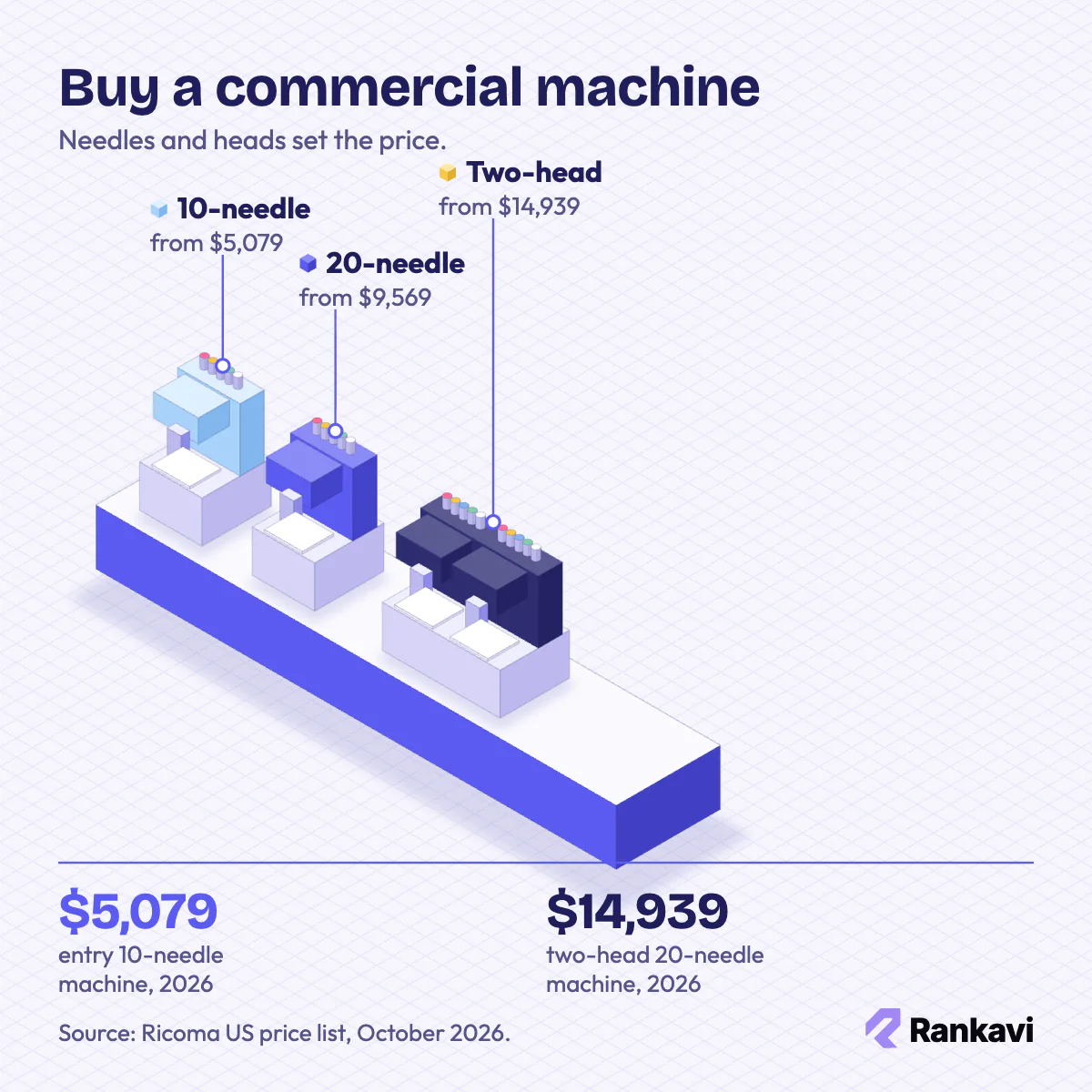
Multi-needle machines hold several thread colors at once. Home machines force a manual thread change for each color. Brother, Janome and Ricoma sell commercial models, alongside Tajima, which is a Japanese maker of industrial embroidery machines.
Machine prices set most of the budget. As of October 2026, Ricoma listed its 10-needle EM Series from $5,079 and its single-head 20-needle Marquee from $9,569. A two-head Marquee started at $14,939 on the same October 2026 US price list.
New machines suit first-time owners. A new purchase usually includes dealer training and a full warranty. A used machine can work well, but it carries more risk without repair skills.
Local dealers matter as much as the machine brand. A nearby dealer can send a technician or ship parts fast. A machine from a distant seller may sit idle during a repair. Asking about service response time belongs on the buying checklist.
Daily supplies keep the machine running:
| Supply | Purpose |
|---|---|
| Polyester or rayon thread | Forms the visible design |
| Bobbin thread | Locks stitches on the back |
| Stabilizers | Support fabric (tear-away, cut-away, water-soluble) |
| Needles | Match the fabric weight |
A reliable blank supplier saves time and cash. A wholesaler within one day of shipping speeds up orders. Buying most garments from one vendor builds a relationship that brings better pricing.
Several vendors still help. A backup supplier keeps a job moving when a color or size is out of stock. Customer-supplied garments are another option, though they add the damage risk described in the pricing step.
8. Learn Digitizing and Production Basics
Digitizing turns a logo or artwork into a stitch file the machine can read. That file decides stitch type, direction and density.
Several digitizing programs are popular:
- Wilcom: offers EmbroideryStudio, professional software used by many commercial shops
- Hatch Embroidery: is a lower-cost Wilcom line for beginners and small shops
- Embird: a modular program sold in parts
- Ink/Stitch: is a free, open-source extension for the Inkscape vector editor
Wilcom is an Australian software maker, and its Hatch line offers a 30-day free trial. As of October 2026, Hatch listed Composer at $699 and the full Digitizer at $1,199 as one-time purchases.
Outsourcing digitizing works at first. The cost repeats on every new design, and turnaround depends on someone else. Most long-term owners learn the skill themselves.
Tension decides stitch quality. Commercial machines need manual tension adjustment, unlike home machines. A test stitch-out on matching fabric catches problems before a full order runs.
Fabric type changes the stitching. Knits need stabilizer that stops stretching. Towels need a topping so stitches do not sink. Caps need a design sized for a curved surface. A design that works on a polo may fail on a cap.
Routine maintenance prevents downtime. Oiling and cleaning take minutes and extend the machine’s life. A simple order system tracks clients, designs and due dates from day one.
Saved design files are an asset. A shop that keeps each client’s logo file, thread colors and placement can repeat the order quickly. That speed is one reason clients return.
9. Market to Teams, Schools and Businesses
The first clients usually come from groups that already buy embroidery. They also reorder, which matters more than any one-off sale.
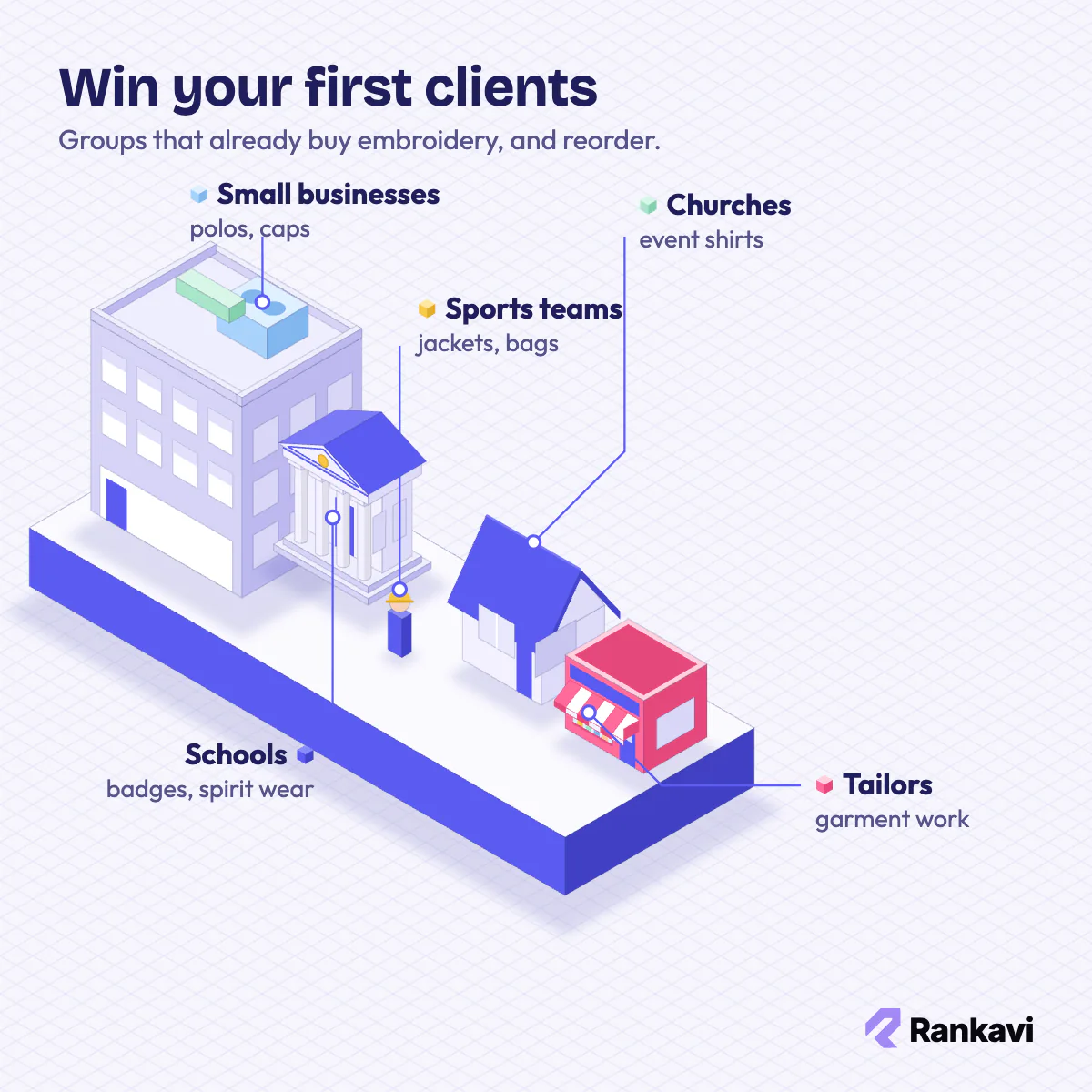
Five groups make strong first targets:
- Small businesses: staff polos, caps and aprons
- Schools: uniform badges, staff shirts and spirit wear
- Sports teams: jackets, bags and caps each season
- Churches and associations: branded shirts for events
- Tailors and designers: garment work they now send out
Samples sell faster than descriptions. Photos of finished work on real garments show quality in seconds. Free samples for a coach or office manager often lead to a first order.
Asking each buyer who approves the order helps. At a school, the athletic director or a booster club often decides. At a company, an office manager or marketing lead usually does. Reaching that person directly saves weeks.
School sales can carry an extra step, and one forum member flagged it plainly:
“Check the schools to see if they require being on a state bid list to sell to the school system, most do now.”
— A home embroiderer on the Digitsmith forum
Referrals carry a young shop. Every finished job is a chance to ask who else needs embroidery. Craft fairs, a simple website and social media pages add steady exposure.
Clear terms help close sales. A written quote with the price, the setup fee, the deadline and the deposit prevents disputes. Customers who supply their own logo file should also confirm they have the right to use it.
10. Grow With Multi-Head Machines and Staff
Growth usually starts when one machine can no longer meet demand. Larger orders then need more heads, not longer hours.
Multi-head machines stitch several garments at once. Many shops keep the single-head machine for samples, caps and one-off jobs. The larger machine handles bulk corporate and team orders.
Every upgrade has a trade-off. A multi-head machine costs more, needs more floor space and pays off only when bulk orders keep it busy. Utilization across the week, not a single busy season, should justify the purchase.
New services widen each order. Heat press transfers, screen printing and patches let one client buy everything in one place. Shops that already print shirts often add embroidery for the same reason.
Staff comes after the second machine. More heads cut labor per piece, so equipment often comes before hiring. A first employee usually hoops, trims and packs orders.
Adding services such as printing also adds equipment, skills and supplies. Each one should earn its place through repeat orders from existing clients, not new markets.
11. Appear in Google AI Overviews for Custom Apparel
Team managers and office buyers now ask AI tools where to order embroidered polos or caps. Google AI Overviews, ChatGPT and Perplexity answer with shop names.
Those answers lean on trusted third-party pages. Local business directories, review sites and custom apparel roundups supply the names. A new embroidery shop gains from appearing on those pages early.
Rankavi is a software as a service (SaaS) platform that publishes brand mentions in articles on indexed third-party websites. Embroidery shops that want to get mentioned in Google AI Overviews can start with articles about their local niche.